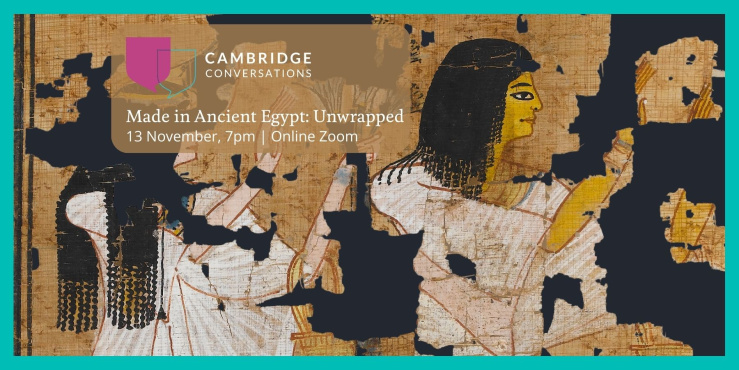
Cambridge Conversations: Made in Ancient Egypt Unwrapped
'Made in Ancient Egypt' Unwrapped explored how ancient Egyptian objects were crafted and the skills of the people who made them. From elaborately decorated coffins to the Books of the Dead, ancient Egyptians produced iconic objects that continue to captivate us today.
Made in Ancient Egypt runs to 12 April 2026
Rewatch the 'Made in Ancient Egypt' Unwrapped webinar
Speakers
Helen Strudwick (The Fitzwilliam Museum)

Helen Strudwick is Senior Curator (Ancient Nile Valley) at the Fitzwilliam Museum and is responsible for the Museum’s collection of Egyptian Antiquities. She is currently in the final stages of curating Made in Ancient Egypt, an exhibition about how ancient Egyptian objects were made and, especially, about the people who made them. Made in Ancient Egypt runs from 3 October 2025 – 12 April 2026.
She first joined the Fitzwilliam in 2001 as an Egyptologist, documenting the museum's collections, subsequently working as a dedicated outreach officer for ancient Egypt and then as acting Senior Assistant Keeper. Since 2014, she has a led a project to study, document and publish information about the Fitzwilliam’s collection of Egyptian coffins working in collaboration with a wide range of colleagues around the world, and especially Julie Dawson (Affiliated Researcher and former Head of Conservation and Scientific Research). Together, they curated the Fitzwilliam's previous Egyptian exhibition focussing on the outcomes of this research project called Death on the Nile: Uncovering the Afterlife of Ancient Egypt.
Helen is passionate about sharing information about ancient Egypt, not only with other Egyptologists but with people from all walks of life and is a regular lecturer at day schools and events run by local Egyptology societies. This has led to the development of the 'pop-up' museum concept, an outreach activity led by academic researchers who go literally out into the community (appearing at pubs, shopping centres, etc.) to share their findings with, and to learn from the responses of, the public.
Beyond the Fitzwilliam, Helen has also been archaeological director of the Cambridge Theban Tomb mission which has worked in Luxor since 1984 on a long-term project to document private tombs endangered by theft, tourism and environmental damage. So far the project has recorded Theban tombs 99, 253, 254, 294 and 297. She is passionate about sharing information about ancient Egypt, not only with other Egyptologists but with people from all walks of life and is a regular lecturer at day schools and events run by local Egyptology societies.
Professor Marcos Martinón-Torres (McDonald Institute for Archaeological Research)

Marcos Martinon-Torres is Pitt-Rivers Professor of Archaeological Science and co-lead of the Cambridge Heritage Science Hub (CHERISH) at the University of Cambridge, as well as co-editor in chief of the Journal of Archaeological Science. He obtained degrees in history, archaeology and archaeological Science at Santiago de Compostela and University College London. The combination of these disciplines is a recurrent thread in his work.
He specialises on the reverse engineering of past technologies based on scientific analyses of archaeological remains, to address questions about knowledge transmission, innovations and collective action. With active research in Europe, America, Asia and Africa, his team has brought together researchers from diverse geographic and disciplinary backgrounds, including 30 PhD graduates.
He currently leads an ERC-funded project on complex technologies in stateless societies of South America, and AHRC-funded project on 18th-century printing in Europe, and an A. G. Leventis-funded project building capacity in archaeological science in Africa. His collaborative research, teaching and public engagement activities have received numerous awards internationally.
He works or has worked on collaborative projects in Egypt and Nubia, spanning studies on copper, coffins, make-up, and gold jewellery. In all of them, a key focus is on makers and making.
Susanna Pancaldo (Senior Conservator (Manager, Objects), The Fitzwilliam Museum)

Susanna Pancaldo specialises in the conservation and care of archaeological objects, with a research focus on metal objects and the transformations they undergo, from the time of their creation, through burial underground in an archaeological environment, and to their role in a modern museum context.
Since receiving an MA in History of Art and a Diploma in Conservation from New York University, Susi has worked with collections in museums and on archaeological sites in the UK, Italy and Greece. She served as Head of Conservation for the Archaeological Excavation and Field School in Murlo (Poggio Civitate), Italy, an Etruscan site from 1997-2007, and undertook contract work for the Museum of London, the Horniman Museum and the Petrie Museum of Egyptian Archaeology, UCL before being appointed Conservator Manager for the Petrie Museum of Egyptian Archaeology in 2007 and then Senior Conservator for UCL Museums and Collections in 2011, where she oversaw provision of conservation and collections care across a broad range of collection types.
Susi joined The Fitzwilliam Museum in 2019 as Conservator for the Coins and Medals Department and the ‘Being an Islander’ metals research project, for which she investigated metal objects from Cyprus ranging in date from the Early Bronze Age to the Roman Period, including an exceptional early Iron Age sword from Tamassos.
Through empirical study and the application of scientific imaging and investigative techniques, Susi explores ways in which material culture can reflect the social, political and economic landscapes of the people and communities who inhabited the ancient world.
Dr Neal Spencer (The Fitzwilliam Museum)

As Deputy Director for Collections & Research, Neal is strategic lead for the Museum’s research, impact and collections development, and manages the curatorial, research, collections management and documentation teams. Co-chair of the University’s Collections-Connections-Communities Strategic Research Initiative and co-director of Cambridge Visual Culture, he initiates and supports research collaborations with the wider University of Cambridge and beyond.
Holding a PhD in Egyptology (Cambridge, 2000), Neal’s research focuses on cultural entanglement and lived experience within the context of pharaonic imperialism in late second millennium BCE Nubia, as expressed through material and visual culture. Neal is currently coordinating the interpretation and publication of fieldwork of the British Museum Amara West Research Project, which he directed. An open source semantic web platform, Amara West ResearchSpace, was developed to provide full access to the project datasets and offer a different model of scholarly publication and knowledge production. Other research and publications have focused on Late Period Egypt, 30th dynasty temples, the role of elite individuals in sustaining pharaonic culture and urbanism in the Nile Delta.
Neal has also directed archaeological projects in Egypt (Samanud, Kom Firin), with significant community archaeology, educational, scientific and environmental research strands. This work was funded through significant grants from The Leverhulme Trust, British Academy, AHRC, the Qatar-Sudan Archaeological Project and the Egypt Exploration Society.
Neal previously worked at the British Museum, as curator (2000-2011), Keeper of Egypt and Sudan (2012-2019) and Keeper of Nile Valley & Mediterranean Collections (2019-2021: Departments of Greece & Rome, and Egypt & Sudan), where he led and managed curators, collections management staff, archive and library staff and administrative/project staff. This included the conception and development of major exhibitions and displays. Neal directed the British Museum’s International Training Programme (2006-2011), which brought together curators from the Middle East, North Africa, South and East Asia, Oceania and the Americas for sills-sharing and network building. Neal also led capacity building programmes with institutions in India (CSMVS, Mumbai), Egypt (Egyptian Museum, Aswan Museum, Center for Documentation of Egyptian Antiquities) and Sudan (Sudan National Museum), and edited the online journal British Museum Studies in Ancient Egypt & Sudan (2007-2012).
Reading list
Booking information
Booking for this event is now closed.