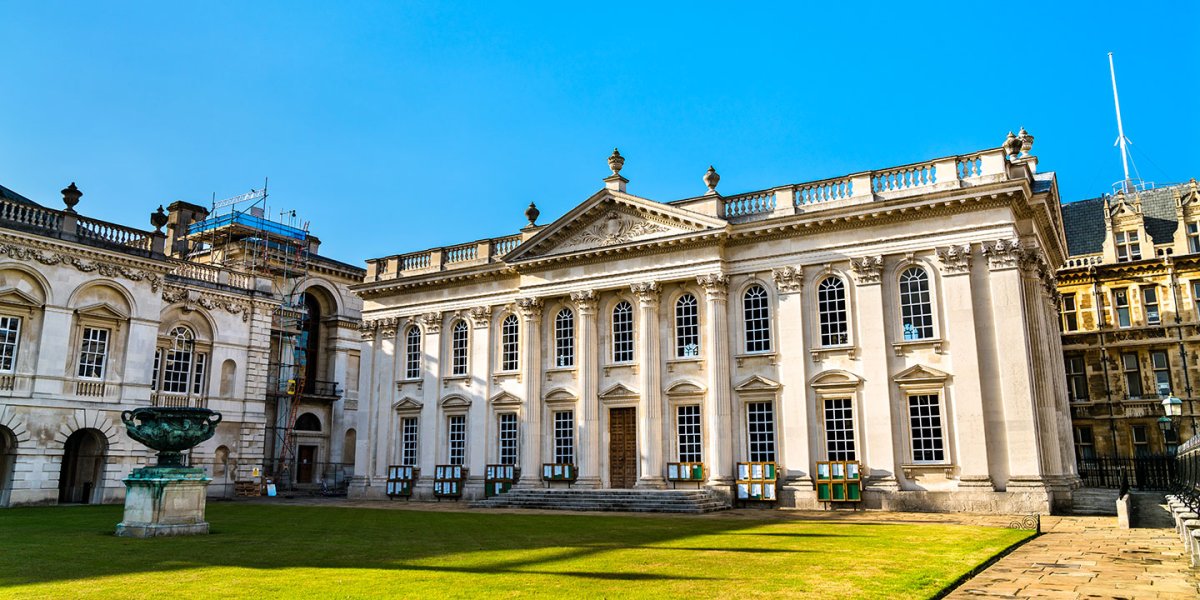
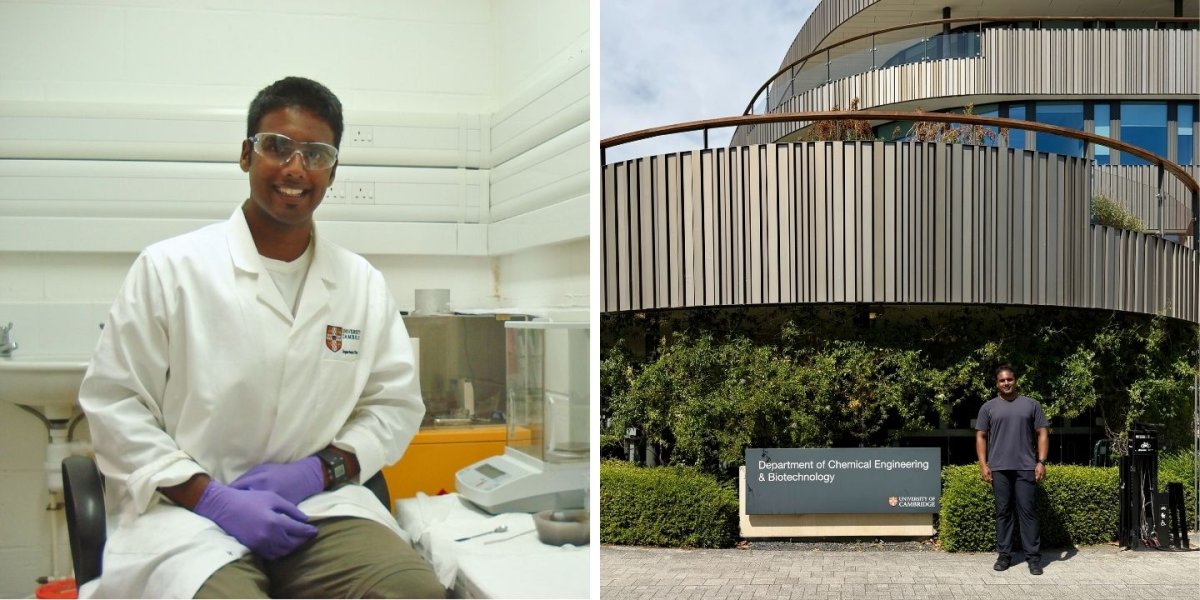
Akshay in 2011 in the old Department of Chemical Engineering and Biotechnology (left) and in 2026 outside the new building (right).
Always in Cambridge: advancing solutions for clean water, energy and materials
For Akshay Deshmukh (Gonville & Caius 2009), Cambridge has been a constant thread, woven through his academic journey, his global research experiences, and now his return to establish his own research group at the University.
"There’s a lot of exciting work going on [in India] in the critical metals and water space and I’d love to be more involved."
“I started as an undergraduate here in 2009,” he recalls, studying chemical engineering and discovering both the research environment and the global sustainability challenges that would come to shape his career. Through research placements in the summer vacations, he began to explore how fundamental science could be applied to urgent, real-world problems.
Born and brought up in London by parents who migrated from India in the 1970s, Akshay’s academic path would soon take him far beyond Cambridge while, in an unexpected way, keeping him within it.
A global journey shaped by Cambridge
After completing his undergraduate degree, Akshay moved to the United States for a PhD at Yale University, his first experience of the country. There, he was drawn to research addressing global water scarcity, working on the design of more efficient desalination systems to convert seawater into fresh water.
The scale of the challenge is stark: data from 2016 showed that around two-thirds of the world’s population lived in water-scarce regions, a situation he notes has only worsened in the years since. Akshay became increasingly motivated by the potential of research to make a tangible difference.
After six years at Yale, Akshay began a postdoctoral position at MIT, focusing on the treatment and concentration of highly saline industrial waste streams. Devising computational models, he explored how new processes could reduce pollution and prevent contamination of freshwater systems.
Across these moves, a curious pattern emerged. From Cambridge in the UK, to Yale (where the residential colleges were modelled on Cambridge and Oxford) and then to Cambridge, Massachusetts, his academic journey was following a common thread!
Now, supported by a UKRI Future Leaders Fellowship and a forthcoming Royal Academy of Engineering Green Future Fellowship, he has returned once again to Cambridge, this time to build something of his own.
Rethinking sustainability: water, energy and materials
At the heart of Akshay’s work lies a set of interconnected challenges: clean water, clean energy and the sustainable use of resources.
His current research focuses on “critical metals” that are essential to the transition to clean energy technologies, especially lithium, which is a crucial component of batteries. Demand for these resources is expected to increase tenfold over the coming 10–15 years, yet their extraction remains resource-intensive.
As an example, says Akshay, “producing one kilogramme of lithium can require more than 700 kilogrammes of water” alongside substantial energy and chemical use that can lead to environmental degradation and pollution.
“We’re moving from a fossil-fuel-based economy to one driven by clean energy minerals,” he explains, but the challenge is ensuring that the processes used to obtain those minerals are themselves sustainable.
His work addresses this challenge by focusing on brines: salty, mineral-rich waters found in natural environments such as salt lakes in South America, geothermal sources in Cornwall, and industrial or recycling processes. These complex fluids contain valuable metals, but the difficult task is to separate them efficiently and cleanly.
Akshay’s ambition is to design new systems capable of extracting these materials while minimising environmental harm. At its most fundamental level, he describes a future in which brines could be processed in a way analogous to oil refineries, whereby complex mixtures are separated into a range of valuable outputs for the clean energy economy.
Building a research group in Cambridge
Back at the University of Cambridge, Akshay is now looking to establish his own research group.
His work will combine computational modelling, to understand how ions move within complex mixtures, with experimental studies to develop new materials and processes for metal separation. As the project develops, collaboration will be key, both within Cambridge and with partners internationally.
Returning to Cambridge has brought a sense of continuity. Former mentors remain part of the department, and Akshay now finds himself working alongside those who first influenced his academic path. While the city itself has developed significantly in 12 years, including the new West Cambridge building for his department, and “the rail station almost unrecognisable!”, its role in his journey remains constant.
Looking ahead: global collaboration and impact
Looking to the future, Akshay is keen to strengthen connections beyond Cambridge, including with India, where he sees opportunities for collaboration to tackle areas such as waste streams and resource recovery. He notes: “There’s a lot of exciting work going on there in the critical metals and water space and I’d love to be more involved.” In the textile sector, for example, industrial processes can generate significant water pollution, where “there’s a really big scope for innovation.”
For Akshay the journey has come full circle. In returning to Cambridge, he is now laying the foundations for the next stage of a career connecting cutting-edge research with real-world impact, to address some of the most pressing environmental challenges of our time.
Share this page