Online

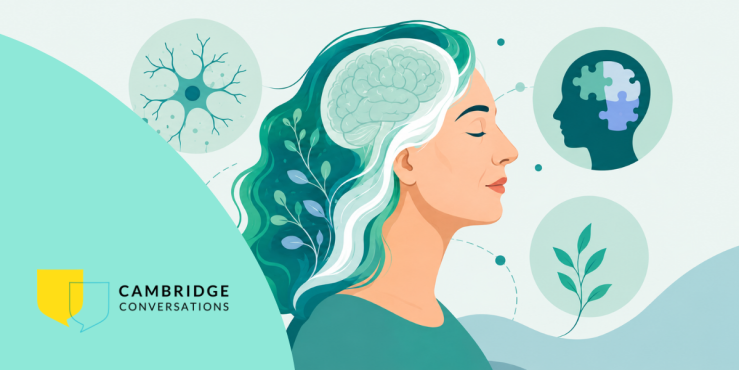
Join us for the second instalment of our Cambridge Conversations series exploring women's health, where leading Cambridge researchers and clinicians come together to discuss the latest thinking on menopause and its impact on brain health.

Menopause is a significant life transition that affects millions of women worldwide, yet many aspects of its influence on cognition, behaviour and overall wellbeing remain poorly understood. In this thought-provoking conversation, our expert panel will explore the latest research, clinical insights and emerging perspectives on the relationship between menopause and brain health.

Together, they will discuss:

  • How menopause influences the brain and cognitive health
  • The effects of sex hormones on cognition and behaviour
  • Clinical perspectives on the whole-body changes associated with menopause
  • Challenging taboos and misconceptions surrounding menopause

This interactive webinar will offer evidence-based insights into one of the most important and widely experienced stages of women's health, highlighting both scientific advances and practical considerations for understanding menopause today.

Speakers
Professor Amanda Sferruzzi-Perri
Professor in Fetal and Placental Physiology University of Cambridge, Fellow St John's College
portrait photograph of Professor Amanda Sferruzzi-Perri wearing a white lab coat

Professor Amanda Sferruzzi-Perri is a world-leading expert in fetal and placental physiology at the University of Cambridge. A developmental physiologist, her research seeks to uncover how the dynamic relationship between the mother, placenta, and fetus shapes pregnancy success and influences health across the lifespan. Her work is transforming understanding of pregnancy complications and the early-life origins of disease, with far-reaching implications for maternal and child health worldwide (https://www.pdn.cam.ac.uk/directory/amanda-sferruzzi-perri).

After completing her PhD at the University of Adelaide, Amanda established her research group at Cambridge through a series of highly competitive fellowships, including a Royal Society Research Fellowship. She was appointed to a permanent academic position in 2019 and promoted to Professor in 2022. She now leads an internationally recognised research programme that combines innovative pre-clinical models with donated human samples, working in collaboration with researchers across the globe to address some of the most pressing challenges in reproductive and developmental health.

Amanda has published over 100 scientific papers, and her research is currently supported by major awards from the Wellcome Trust and the Biotechnology and Biological Sciences Research Council (BBSRC). Her contributions have been recognised with numerous prestigious honours, including the Hans Sigrist Research Prize, a Lister Institute Prize, the Society for Reproduction and Fertility Young Investigator Award, and the Andrée Gruslin Award from the International Federation of Placenta Associations.

Beyond her research, Amanda is a passionate advocate for science, an inspiring mentor, and a committed communicator, actively engaging in public outreach and education to support and train the next generation of scientists.

She is also leading the University of Cambridge’s mission to advance understanding of women’s biology and health, a major cross-disciplinary initiative aimed at accelerating research, education, and impact in this historically under-represented area of science (https://www.bio.cam.ac.uk/research/womens-biology-and-health).

Professor Barbara Sahakian
Professor of Clinical Neuropsychology at the Department of Psychiatry, University of Cambridge Department of Psychiatry, Fellow Clare Hall
photograph of barbara sahakian

Professor Barbara J. Sahakian is Professor of Clinical Neuropsychology at the Department of Psychiatry, University of Cambridge.
She is a Fellow of the British Academy and the Academy of Medical Sciences, and a past President of both the International Neuroethics Society and the British Association for Psychopharmacology. Widely recognised as one of the world’s leading researchers in Neuroscience and Psychology (Research.com), she has made pioneering contributions to the understanding of the neural basis of cognitive, emotional, and behavioural dysfunction.

Professor Sahakian’s research is dedicated to improving the early detection and differential diagnosis of neuropsychiatric disorders and to developing more effective pharmacological and psychological treatments. Her lab conducts proof-of-concept studies with cognitive-enhancing drugs and uses a range of techniques, including neuropsychological testing, neuroimaging (fMRI and PET), psychopharmacology, and genetics. Participants include both healthy volunteers and patient groups with conditions such as brain injury, Alzheimer’s disease, ADHD, OCD, depression, mania, and substance use disorders.

A co-inventor of the CANTAB computerised cognitive tests, widely used in both clinical and research settings worldwide, Professor Sahakian has also co-developed the EMOTICOM battery for social and emotional cognition, as well as cognitive games such as PEAK Wizard and Decoder. Her recent research has expanded into pharmacogenomics and neuroethics, driven by findings on substances like methylphenidate, modafinil, atomoxetine, and MDMA.

She has published over 550 scientific papers in leading journals including Science, Nature, and The Lancet, with an h-index of 159 (Google Scholar). She has contributed extensively to science policy, notably as part of the UK Government’s Foresight Project on Mental Capital and Wellbeing, and was an invited speaker at the World Economic Forum in Davos in 2014.

In addition to her academic work, Professor Sahakian is a passionate science communicator. She is the co-author of two acclaimed books published by Oxford University Press—Bad Moves: How Decision Making Goes Wrong and the Ethics of Smart Drugs and Sex, Lies & Brain Scans (winner of the British Psychological Society Popular Book Award)—and writes regularly for The Conversation.

She holds both a PhD and a DSc from the University of Cambridge and is a qualified Clinical Psychologist. 
 

Dr Madeleine Lameris
Clinical Director of Studies and Fellow at Murray Edwards College
photograph of madeleine lameris

Madeleine qualified from Norwich Medical School in 2007. She worked in hospital medicine and qualified with MRCP in 2011 before completing the MRCGP in 2014. Having worked as a GP in the East of England, providing support and expertise in women’s health & contraception since 2014, she now works clinically for Cambridge Women's Health providing evidence-based care, treatment and information for people during the perimenopause and menopause. She is a trainer for the College of Reproductive and Sexual Healthcare, and a Breast Specialist Physician at Cambridge University Hospital. She is the Curriculum Integration Lead for Cambridge Clinical School, having previously worked for GPEG who provide the GP component of Cambridge University’s Clinical Course. She also teaches on the pre-clinical course and works to increase connections with the clinical years. She has been a Fellow at Murray Edwards and a Clinical Director of Studies since 2023. 

Professor Amy Milton
Professor of Behavioural Neuroscience and Fellow at Downing College
photograph of amy milton

Amy is a University Professor in Behavioural Neuroscience in the Department of Psychology at the University of Cambridge, and Director of the Cambridge MiND Lab. Her research focuses on the neurochemical and molecular mechanisms underlying memory reconsolidation, and their exploitation to develop new treatments for mental health disorders. She also has a strong interest in the development of translationally relevant models of mental health disorders, and facilitating dialogue between basic and clinical neuroscientists working in mental health.

​Amy did her undergraduate degree in Natural Sciences (Neuroscience) at the University of Cambridge, before completing her PhD in the (then) Department of Experimental Psychology at Cambridge under the supervision of Professor Barry Everitt. She was awarded a Research Fellowship in Experimental Psychology at Downing College, Cambridge, which she held for a year before taking up a fixed-term lectureship in the Department of Experimental Psychology at Cambridge. She was appointed a University Lecturer in 2013, achieved tenure in 2018, and was promoted to a full professorship in 2022. She has been the Ferreras-Willetts Fellow in Neuroscience at Downing College, Cambridge, since 2011.

​Amy's research has applications to mental health disorders including drug addiction, post-traumatic stress disorder, and obsessive-compulsive disorder, with support by the UK Medical Research Council (MRC), the Wellcome Trust and the Biotechnology and Biological Sciences Research Council (BBSRC). Her work has been covered by a number of media outlets, and has been recognised with awards from the European Behavioural Pharmacology Society. (2017) and the British Association for Psychopharmacology (2022). She was the General Secretary of EBPS from 2021-2025, and edits for numerous journals including Pharmacology, Biochemistry & Behavior and Scientific Reports.

Contact information
Events Team
Tel: +44 (0)1223 33 22 88
Booking information Booking opens: Tuesday 15 September 2026, 12.01am