
CAM's summary of what's been happening across the University.
Honorary doctorates - Stormzy recognised with doctorate for Scholarship for Black Students scheme
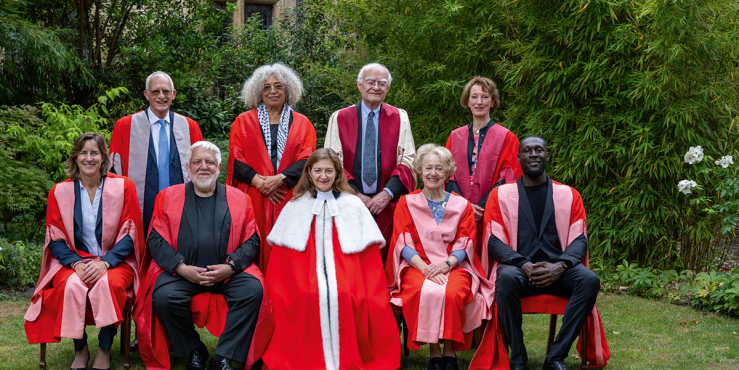
Owuo Jr – better known as Stormzy – to receive his honorary Doctorate in Law? “It’s not as impressive as you lot,” he said with a grin, when meeting some of the Stormzy Scholars to whom he’s provided financial support through the Stormzy Scholarship for Black UK Students since 2018.
Sitting down with the BBC’s One Show after the ceremony, Stormzy admitted that initially he didn’t want to meet the recipients. “I didn’t want the students to feel like they owed me anything. But to actually sit down with them, talk to them, hear their stories – and you’re like, damn, this is real. A lot of them actually say that they wouldn’t have applied without the scholarship being there.”
Stormzy joins a further seven leading figures from the worlds of art, music, sport, science and politics who were honoured.
“Each has made an extraordinary contribution to their field, and their work continues to inspire people in Cambridge and around the world,” says Vice-Chancellor Professor Deborah Prentice. Actor Sir Simon Russell Beale and political activist Professor Angela Davis received a Doctorate in Letters, while former Justice of the UK Supreme Court Lady Arden of Heswall and Olympian Dame Katherine Grainger joined Stormzy in receiving a Doctorate in Law.
The Nobel Prize-winning economist Sir Oliver Hart received a Doctorate in Science. Professor Maria Leptin, President of the European Research Council, received a Doctorate in Medical Science. And Sir John Rutter, Director of Music at Clare from 1975 to 1979, received a Doctorate in Music.
Big number
£100 million committed by VC firm Cambridge Innovation Capital to invest in spinouts from the University of Cambridge.
Technology
NHS cancer patients at Addenbrooke’s Hospital will become the first in Europe to have incisionless ultrasound surgery using new cutting-edge technology. The Edison Histotripsy System was purchased thanks to a generous donation from philanthropist Sir Ka-shing Li, a longstanding supporter of cancer research at the University. It will be fully installed later this year.

Masha Krasnova-Shabaeva
Two-minute Tripos
A new interpretation of an English legend alters our entire understanding. Discuss.
I’m pitching a new Game of Thronesstyle epic to Netflix. It’s got it all! Elves! Water sprites! And best of all, the IP is out of copyright.
If there’s one thing we need more of, it’s Game of Thrones-style epics. Will characters explain vital plot points to each other while lying around in various states of undress?
There are other ways of moving a plot along?
Fine. What’s it called?
Well, I give you… the Song of Wade! A long-lost treasure of English culture and a rip-roaring tale of elves and water sprites.
You keep saying ‘elves and water sprites’ like it’s the only thing we know about the Song of Wade.
That’s because it is the only thing we know about the Song of Wade. A medieval preacher refers to it: “Thus they can say, with Wade: ‘Some are elves and some are adders; some are sprites that dwell by waters.’”
What if I were to tell you that the sermon in which that reference to the Song of Wade was made has been mistranslated ever since it was first discovered in 1896 by MR James?
I would take no notice.
And that the phrase is actually “Some are wolves and some are adders; some are sea snakes that dwell by the water.”
We can have a sea snake battle.
Which makes it obvious that the lost Song of Wade is not in fact a fantasy epic but a chivalric romance, alluded to by a preacher to make a point about how men are animals?
Exactly! It’s open to many different and valid interpretations. The internet will love it. Like kittens and ASMR.
I give up.
Anyway, Cillian Murphy to play the elf?

Lloyd mann
Chancellor
Chris Smith, Baron Smith of Finsbury – the former Master of Pembroke – has been elected as the University’s 109th Chancellor. He will hold the office for 10 years.
In a historic first, the election was opened to online voting. More than 23,000 alumni and staff participated, choosing from a shortlist of 10 candidates.
But almost 2,000 people still chose to vote in person at the University’s Senate House.
Born in 1951, Lord Smith was educated in Edinburgh before coming up to Pembroke, achieving a double first in English, and he was also a Kennedy Scholar at Harvard.
He became MP for Islington South and Finsbury in 1983 and held a number of frontbench posts in the shadow cabinet before Labour came to power in 1997.
He served as Secretary of State for Culture, Media and Sport until 2001 when he returned to the backbenches. In 2005, he stood down from the House of Commons and was made a life peer.
He chaired the Environment Agency from 2008 to 2014 and was also Chairman of the Advertising Standards Authority.
Being elected is a huge honour, he says. “I look forward to being the best possible ambassador for Cambridge, to being a strong voice for higher education more generally, and to working closely together with the Vice-Chancellor and her team.” Read about Chris Smith’s life in music in Soundtrack.

Illustration by Masha Krasnova-Shabaeva
The Guardian launches whistleblowing tech developed by Cambridge research
Deconstructed
The Guardian launches whistleblowing tech developed by Cambridge research
Whistleblowers can now contact journalists more securely, thanks to new confidential technology co-developed by Cambridge researchers and The Guardian.
The Secure Messaging function in The Guardian’s mobile news app is a secure and simple way for sources to get in touch with journalists in confidence.
The app has a range of other functions, too, including digital ‘dead drops’ – like virtual park benches or bins – where journalists can retrieve messages left by whistleblowers.
It builds on CoverDrop technology that was developed at Cambridge. The code is online and open source to encourage other organisations to follow The Guardian’s lead.
In brief
THE END OF CHEESY CHIPS
Sad news from Rose Crescent – it’s time to say a final kalinikta to a Cambridge institution: Gardies. After 76 years, the famous Greek takeaway, The Gardenia Restaurant, has officially closed, leaving late-night – or, frankly, anytime – revellers in search of a revitalising pitta and chips bereft.
JUST A GUT FEELING
Cambridge researchers have discovered that certain species of microbe found in the human gut can absorb toxic and long-lasting ‘for ever chemicals’ known as PFAS, linked with a range of health issues including a higher risk of certain cancers and cardiovascular diseases. The researchers – from the MRC Toxicology Unit – now hope to create supplements that protect against the toxic effects of PFAS.
BREAKTHROUGH TREATMENT
Twelve years ago after Cambridge researchers first identified a rare genetic hereditary illness – activated PI3-kinase delta syndrome (APDS) – 19-year-old Mary Catchpole has become the first person to be treated for it. APDS ‘switches on’ an enzyme that prevents immune cells from fighting infection, but the new treatment inhibits the enzyme and normalises the immune system.