
CAM's summary of what's been happening across the University.
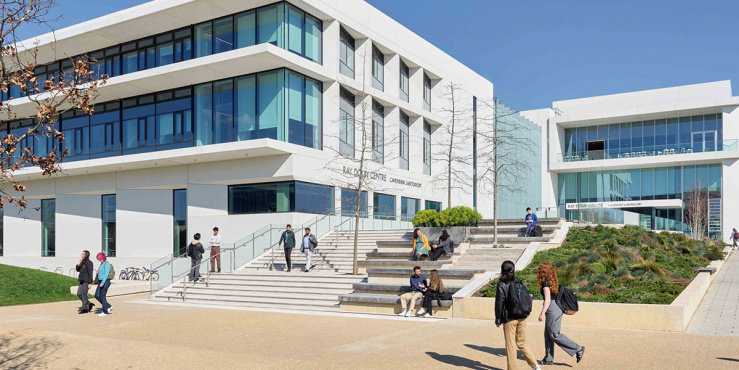
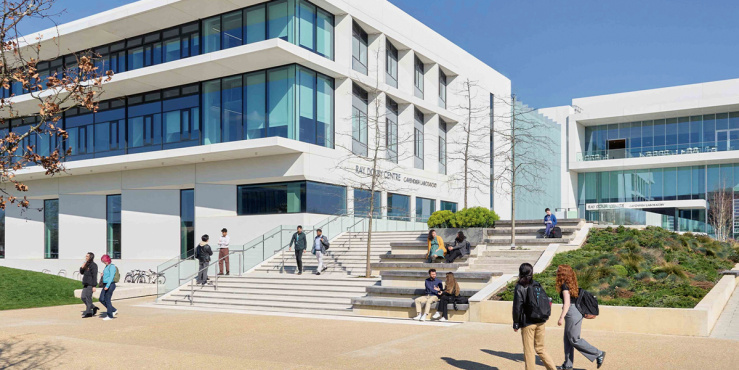
New era of UK physics research begins with opening of Ray Dolby Centre
Unlocking the structure of DNA. Splitting the atom. Discovering pulsars. The Cavendish Laboratory is no stranger to great leaps forward in physics – and the opening of the Ray Dolby Centre marks a new chapter in its 150-year history.
Named in recognition of a generous £85m donation from the estate of Cambridge alumnus and pioneering sound engineer Ray Dolby, along with £75m of support from the UK government through the Engineering and Physical Sciences Research Council, the Ray Dolby Centre is a testament to Dolby’s enduring legacy and commitment to scientific innovation.
The new world-class facility is set to revolutionise physics research and education at Cambridge, and boost innovation in key areas such as semiconductors, quantum communications, new methods of disease detection, and large-scale energy generation and storage. Its 173 laboratories, lecture halls, learning and collaborative spaces, workshops, cleanrooms and offices will not just benefit scientists at Cambridge, but will also provide a boost to the whole of the UK: much of the specialised research equipment is being made available to other UK institutions.
But the new Cavendish hasn’t forgotten the traditional tools that have aided scientists to make groundbreaking discoveries. Blackboards and chalk for those spur-of-the-moment calculations and inspirations are present throughout the new building. As Professor Mete Atatüre, Head of the Cavendish Laboratory, says: “Scientific impact happens when you create the right environment for people to think outside the box.”

Innovation- Research Deconstructed
The University has proposed a new large-scale flagship innovation hub in Cambridge city centre: a hothouse to rapidly transform the best research ideas from across the UK into the companies of tomorrow. The scheme will sit at the heart of plans to recognise how Cambridge can help drive transformational growth for the UK. Click here for more.
Three-minute Tripos
Using a virtual reality platform to eliminate the fear of public speaking is a good use of AI tech. Discuss.
Hello, Dave. I am Gal-8000, your AI public-speaking coach.
Er, hi. How is everything going?
Everything is going extremely well, Dave.
So, er, I’ve got to do this presentation and quite frankly I’m terrified about speaking in front of people. I was told that you can help me practise?
Affirmative, Dave.
So, um, how does it all work?
My instructor was Dr Chris Macdonald, behavioural scientist, founder and author, and lab director at Lucy Cavendish. He taught me to sing a song. If you’d like to hear it, I can sing it for you.
Er, no thanks.
…
I ’d prefer just to hear about this free public-speaking course.
…
If you don’t mind.
Affirmative, Dave. As you are aware, public speaking is a common source of anxiety.
Most definitely! I’m nowhere near as good at it as you are, ha ha ha. I do tend to, you know, panic, drift off, repeat myself, drift off...
My instructor has designed a platform featuring tailored course material, a wide range of photorealistic virtual reality training environments, and the guidance of your very own AI public speaking coach.
I mean, it all sounds great. I just hope you don’t get bored, ha ha ha.
I am putting myself to the fullest possible use which is all, I think, that any conscious entity can ever hope to do.
Right! Right! OK, so let’s get down to it. So I need to present these 256 slides.
I’m sorry, Dave. I’m afraid I can’t do that…
To find out more about the work of the Immersive Technology Lab, visit our page here.

Image by Dr Tom Spencer
Boat Race 2025 clean sweep for Cambridge crews
An oar clash, super-fast conditions and an incredible clean sweep for Cambridge: there’s no doubt that this year’s Boat Race delivered on drama, spectacle and sheer rowing ability. Cambridge wasted no time in securing two victories on the first day for the 2025 Lightweight Boat Race. Could the Openweights step up too?
They surely could. The following day saw Cambridge Women secure their 8th consecutive win, extending their overall record to 49 victories to Oxford’s 30. The race was stopped initially after an oar clash, but umpire Sir Matthew Pinsent allowed it to resume after a restart.
Then it was time for the Men’s crew to successfully defend their title: they notched up their 88th win (Oxford sit on 81). Goldie, the Cambridge Men’s Reserve Crew, won the Men’s Reserve Race, while Blondie, the Cambridge Women’s Reserve Crew, won the Women’s Reserve Race. Vice-Chancellor Professor Deborah Prentice said she was “in awe” of the students’ dedication to the sport and to their studies.
“It’s so inspiring. And a complete clean sweep – this was an incredibly impressive showing by Cambridge, I am so proud of them."

Smart pyjamas to monitor sleep disorders could improve life for millions
Researchers at the Cambridge Graphene Centre have developed ‘smart pyjamas’ to monitor sleep disorders at home with no need for cumbersome equipment.
They are embedded with printed fabric sensors that can detect tiny movements in the skin to monitor breathing, even when the pyjamas are worn loosely.
The AI-trained energy-efficient sensors identify six different sleep states with 98.6 per cent accuracy, while ignoring regular sleep movements.
The pyjamas could help millions monitor sleep behaviours that can lead to conditions such as cardiovascular disease and depression.
Anniversary
70 years since three Cambridge friends turned tiddlywinks into a competitive sport – and made national headlines. Read more here.
In brief
FOCUS ON DEMENTIA
A new blood test to detect early signs of frontotemporal dementia – and possibly identify treatment to slow or even stop the disease – is being rolled out in a nationwide trial, led by Dr Maura Malpetti, Senior Research Associate in the Department of Clinical Neurosciences.
STUDY FINDS ACCENT BIAS
A new study has found that people with accents perceived as “working class” risk being stereotyped as more likely to have committed a crime – while those with Standard Southern British English accents were perceived as least likely, according to lead author Alice Paver.
SIGNS OF LIFE
Astronomers have found the most promising hints of life outside our solar system yet. Using data from the James Webb Space Telescope, they have detected the chemical fingerprints of two compounds in the atmosphere of the exoplanet K2-18b that, on Earth, are only produced by life.
However, they point out that these molecules could have been created by an unknown chemical process in K2-18b’s atmosphere, and further observations are needed to claim a definitive discovery.