
 CAM
CAMPhotography: Adam Lawrence
Easter- Editor's letter and inbox
Welcome to the Easter edition of CAM
Published on:
13 July 2026
Welcome to the Easter edition of CAM, which means that exam season is… over!
And what better way to celebrate than with a big night out, and possibly a late night refuel at that most Cambridge of institutions, the Trailer of Life.
This feature of the city’s nightlife has been serving burgers, quesadillas and cheesy chips to grateful customers for more than 30 years, and on page 20 we hear from some of those who have enjoyed its healing powers about just what makes it so special.
Quite whether a diet of fast food is the secret to a long life we can’t say, but on page 12 we look at what ageing well does actually look like, and the work of the Centre for Research in the Arts, Social Sciences and Humanities in redefining what it means to be old – and get older.
Some of the examples from around the world are truly inspiring.
Elsewhere we look at how the multi-agency Endangered Landscapes and Seascapes Programme is reversing the toll human activity has taken on natural habitats in and around the River Thames, and is restoring the estuary to its former glory.
We hear how Professor Tim Dalgleish has made it his mission to act on our affective system – the “life or death system in our heads” – specifically to improve young people’s mental health.
On these topics – and on all things Cambridge – we look forward to your contribution to the debate, online at magazine.alumni.cam.ac.uk, by post and email or on social media.
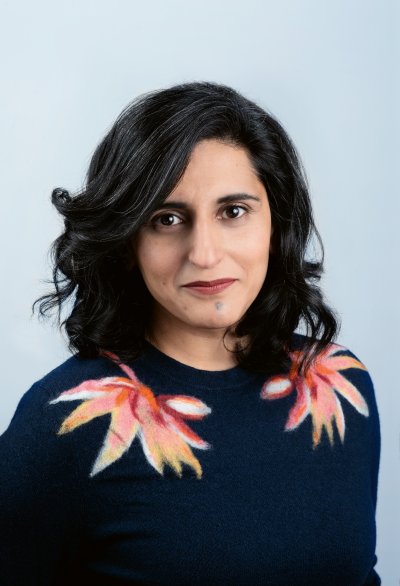
Mira Katbamna
(Caius 1995)
Letters
AI and art
I chuckled when I saw the AI image of me as an “art historian at work”. I am rather less panicked about AI than many (useful in its place, but so far as I have seen no substitute for human creativity). In this case it got my sartorial style very wrong (I’d never wear a jacket like that). But it did capture my fondness for getting up close to sculptures and (where it’s safe to do so!) dispensing with those regulation blue gloves. Mary Beard (Newnham 1973), Professor Emerita of Classics
Varsity
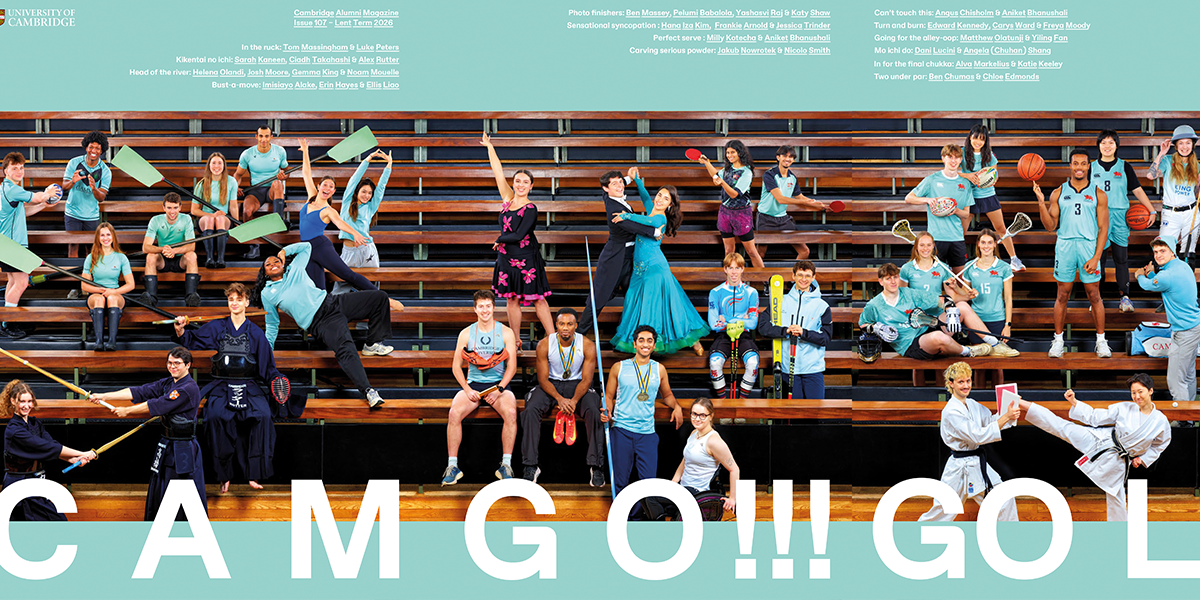
The cover of CAM issue 107 was a lovely idea, from the novelty of the foldout to the photography, colours, setting and the universally cheerful expressions on everyone’s faces. What a wonderfully happy way to celebrate the wide range of sporting activities available. Congratulations! Simon Tuite (Fitzwilliam 1971)
Just a few words of total admiration for the superb Go light Blues spreads in the latest edition! Not only does it make a big impression with its colour and format, but it gives a great view of the range of activities and people taking part in sport at Cambridge. In these times of focus on STEM and AI, it is so important for the health of students that they appreciate how their valuable time at university can be shared with the humanising and interactive relationships enjoyed by participants in sports. Thank you for this inspiration. Dominic Weir (Girton 2015)
DNA
I opened my copy of CAM this morning, eagerly reading all the articles as usual. However, when I came to the article on Crick and Watson (Alumni life) I was astonished that the first sentence read: “The 1959 night at the Eagle pub when Francis Crick and James Watson declared they had discovered the ‘secret of life’ is the stuff of legend.” Every Cambridge alumnus and every tourist visiting the Eagle pub knows that this took place in 1953, not 1959 (as written on the blue plaque outside)! Ranald Spiers (Pembroke 1977)
from the editor: Every alumna, but apparently not this one! Our apologies and thanks to all of you who took the time to write.
Francis Crick’s Nobel Prize was announced a couple of days before the end of term. Varsity’s editor decided to bring out a special edition and I was sent to interview Professor Crick at his home, The Golden Helix. A party was in full swing. I had no idea what Crick looked like so I asked a somewhat bemused looking man nursing a glass of champagne where I might find my quarry. He replied languidly: “Probably upstairs in bed with my wife.” Upstairs were three doors: if I were to fulfil my ambition to abandon my medical studies and become an ace foreign correspondent, I had to follow the story. I couldn’t bring myself to do it, so at that moment my journalistic dreams ended. The next morning’s national newspapers carried photographs of Crick. He was, of course, the bemused looking man with the glass of champagne. Harvey Marcovitch (Sidney Sussex 1960)
Football
I enjoyed Joshua Bland’s piece about the heritage surrounding the supporting of football (Life’s a pitch, CAM issue 107), but I’m not sure about his assertion that football “offers continuity against a broader context of discontinuity caused by deindustrialisation”. There are exceptions to this general rule. Take my own club, Ipswich Town. Not a typical deindustrialised area like the examples that are cited in the article. Indeed, we are patronisingly referred to as the Tractor Boys precisely because of the rural roots in that part of the world. Ipswich Town, or indeed our great rivals Norwich City, do not fit the stereotype of the northern post-industrial football club. Patrick Russell (Wolfson 2020)
Soundtrack
I was taken back more than 65 years by Ruth Barrett’s choice of Das Lied von der Erde (CAM 107). Not knowing the work, but liking what little of Mahler I’d come across, I borrowed it from the University Record Library (housed in Miller’s of blessed memory). That evening I cleared the decks and put it on. Immediately after the orchestral whump at the end of the first movement there was a power cut. Imagine what that did to an 18-year-old lying flat on his back immersed in fin de siècle darkness. To this day I can’t hear Der Abschied – all 30 minutes of it – without remembering that 18-year-old with tears running down his face. Still happens, I’m glad to say. Mike Lunan (Peterhouse 1960)
Foreign languages
Dominic Weir (Inbox, CAM 107) is right about foreign languages. My mother believed in their hidden uses but, as an undiagnosed ocular dyslexic (meaning I have poor visual memory), German proved difficult to learn in my comprehensive, though I benefited from privately organised exchanges. Having gained a First from Liverpool University, but without postgraduate support, my health collapsed due to overwork. Academic references dared not mention dyslexia, in case I failed to get any interviews. Eventually, I did a Quaternary Science MPhil involving volcanological fieldwork in the eastern Eifel, where speaking German was invaluable. David Nowell (St John’s 1998)
Write to us
We are always delighted to receive your emails, letters, posts and comments:
- Email – cameditor@alumni.cam.ac.uk
- By post – CAM, University of Cambridge, 1 Quayside, Bridge Street, Cambridge CB5 8AB
- Facebook – facebook.com/cambridgealumni
- LinkedIn – linkedin.com/school/university-of-cambridge
Letters may be edited for length. Please mark your email: ‘For publication’.
In brief
CLEAN HYDROGEN
A team led by Professor Erwin Reisner from the Yusuf Hamied Department of Chemistry has developed a method to turn recovered car battery acid and plastic waste into clean hydrogen, offering a potential new approach to sustainable fuel production.
VIKING ERA ‘EXECUTION PIT’
A possible Viking era execution pit, containing dismembered remains and complete skeletons dating from the ninth century, has been uncovered by archaeology students at Wandlebury Country Park on the outskirts of Cambridge. The excavation, led by Dr Oscar Aldred from the Cambridge Archaeological Unit, featured in BBC Two’s Digging for Britain and will now undergo further DNA and isotopic analysis.
UNSEEN PETER SHAFFER PLAY
A Trinity PhD student has uncovered a complete unpublished play by Sir Peter Shaffer more than six decades after it was written. Discovered by James Critchley within the playwright’s archive, Our Lady of the Volcano offers fresh insight into Shaffer’s early creative ambitions before Equus and Amadeus established his international reputation. Trinity is marking the centenary of Peter and Anthony Shaffer’s births this year.
POP-UP PLANETARIUM
Cambridge astronomers have launched a free pop-up planetarium designed to bring immersive space exploration directly into schools in the east of England. Developed by the Institute of Astronomy, the portable dome allows pupils to experience fully rendered 3D journeys through the universe, and forms part of the University’s wider commitment to inspiring future generations of scientists.
Photography by Lloyd Mann and Jonathan Settle
University
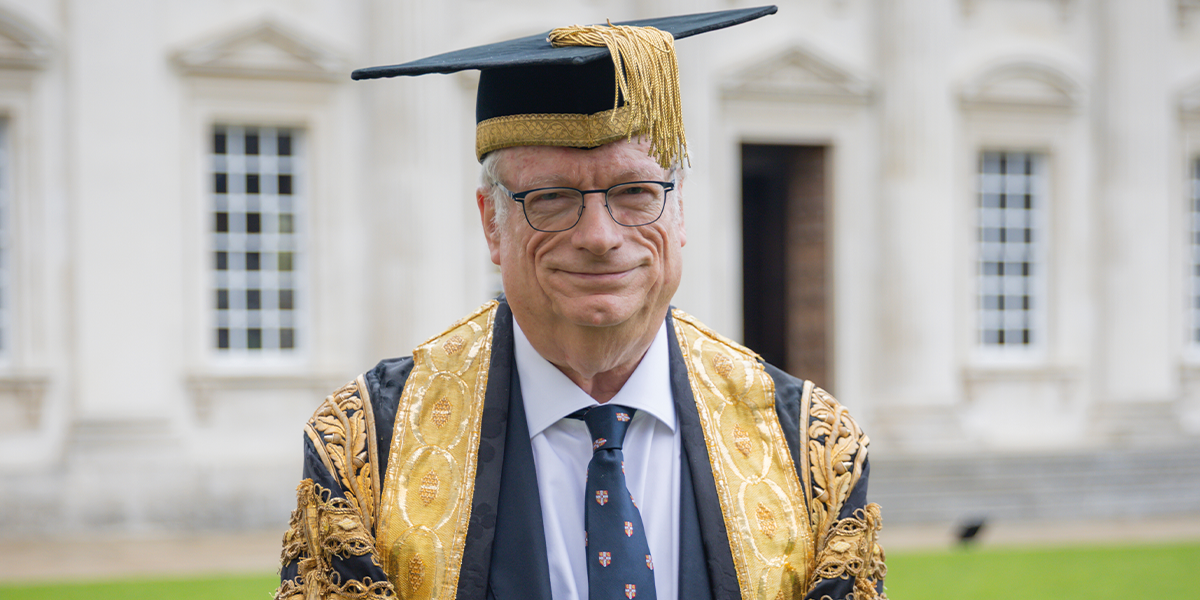
Chancellor Chris Smith champions academic freedom
As Chris Smith, Baron Smith of Finsbury approaches six months as Chancellor, his emphasis on academic freedom continues to resonate across the higher education sector.
Since formally taking office earlier this year, the former Culture Secretary has repeatedly warned against political interference in universities, describing recent pressure placed on leading American institutions as “deeply worrying”.
Speaking shortly after his installation, Lord Smith argued that attempts to dictate what universities can teach or research threaten the foundations of academic life itself.
The remarks came at a time of growing international debate about free speech on campus and the role of universities in public life.
Within Cambridge, his comments were widely interpreted as a clear statement of the values he intends to defend during his decade-long tenure.
Alongside safeguarding academic independence, Lord Smith has also focused on promoting Cambridge as a centre of British innovation and encouraging closer co-operation between the University and its Colleges.
A former Master of Pembroke, Lord Smith brings extensive academic and public experience to the role, having previously studied English at Cambridge before completing doctoral research on the Romantic poets.
Share this page


