
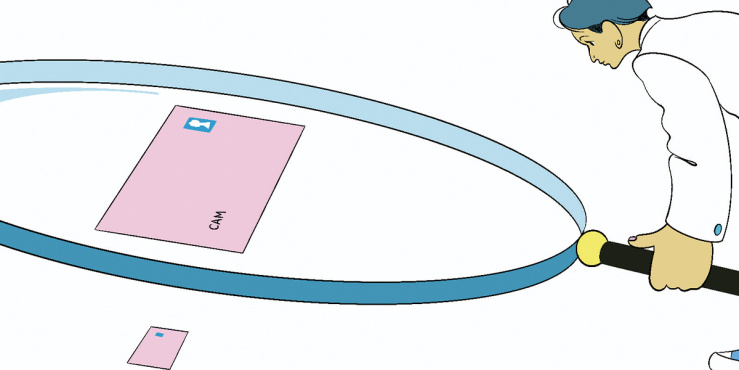
Welcome to the Easter edition of CAM
Welcome to the Easter edition of CAM. Thomas Nelson (Christ’s 1758). Ray Dolby (Pembroke 1951). Sylvia Plath (Newnham 1955). Americans who come to study at Cambridge stand on the shoulders of giants – but what is it really like to follow your dreams over an ocean to a world of ancient buildings and supervisions, bops and bedders?

Meanwhile, what did you have for lunch yesterday? How about this time last week? Or this time a year ago? Perhaps you don’t remember. But perhaps you do remember, in detail, your last lunch at College – or your birthday. On these topics – and on all things Cambridge – we look forward to your contribution to the debate, online at magazine.alumni.cam.ac.uk, by post and email or on social media.
Mira Katbamna
(Caius 1995)
Letters
On the right path
Your piece on the year abroad (CAM 104) brought back memories of my own year in Japan as a Third Year. I was lucky enough to have a work placement in Marui, a famous Japanese department store. When I arrived I realised that my first two years had equipped me for many things, but not all the practical stuff like asking where the loo was! Luckily I soon adapted and learned the store’s own in-house vocabulary, including another, secret code word for ‘loo’ so that customers never needed to know we were talking about bodily functions….
- Caroline Klein née Lewis (Emmanuel 1994)
It is very encouraging to hear of people gaining experience in their cross-cultural encounters, but I would encourage them to consciously also leave something behind for the local people. I worked with the Tzeltal Maya people of south east Mexico as an agricultural missionary for more than 20 years, and have continued going back regularly to help them in their continued battle against climate change and the difficulties of making a living off the land in a sustainable way. The longer one works with these different cultures the greater the enjoyment.
- Bob Short (Emmanuel 1967)
Teaching empathy
The results of Dr Demetriou’s research into the effectiveness of teaching empathy to schoolchildren (School of thought, CAM 104) are most encouraging. I once had the job of assessing the attitudes of GPs on trainers’ courses. It was very gratifying to discover how much their attitudes to teaching GP trainees improved over the course of a week. However, after six months those on the courses displayed a discouraging reversion in their attitudes when retested. I do hope that Dr Demetriou will carry out a similar post-course assessment.
- Tim Paine (Trinity 1959)
A history of History
The article on history (CAM 104) illustrated why historians have little influence on policymakers. On one side were scholars decrying ‘activist’ historians pursuing 21st century social justice goals, and on the other were scholars seeking to ‘decentre the West in history’, and emphasise the role of minorities in past achievements. Both sides might have valid viewpoints, but they should know that policymakers can spot ideological positions dressed up as sober historical analysis from a mile away.
- Graham Pendlebury (Sidney Sussex 1978)
I particularly enjoyed the history feature, but I would say that Robert Tombs has some gall to complain about historians being activists when he writes an ‘anti-woke’ column for The Daily Telegraph and helps to run the right-wing, pro-empire History Reclaimed pressure group with another of your contributors, David Abulafia.
- Thomas Moriarty (Magdelene 2006)
As a Cambridge-trained historian, I was disappointed by the unexpected timidity shown throughout the history feature. As the article makes clear, history is one of the bedrocks of all human understanding, but the resigned and defensive thinking expressed in the face of increasing threats offers no path for the future. It would have been heartening to hear that someone is thinking beyond just its survival on the Cam.
- Stephen Badsey (Sidney Sussex 1974)
A distinctive room It was interesting to see U2 Bodley’s Court in King’s featured recently (My room, your room, CAM 104). The article says the room is now “a little lacking in decoration”. But when I lived there in the late 1950s a previous occupant had fixed a brass rubbing of Roger de Trumpington beside the door to the bedroom, and the rest of the wall was adorned with red wallpaper. It was seen one evening by Michael Jaffé, a Fellow of King’s and subsequently Director of the Fitzwilliam Museum, who said: “I don’t admire it.” But I thought it was quite distinctive!
- Malcolm Drummond (King’s 1956)
I’m a bit surprised that George Bland hasn’t been able to identify the two paintings he was given. The one above his head is of the charming Seine-side village of Vétheuil, which Claude Monet painted in 1879. The other is a bit of a puzzle, but I have concluded it’s a photograph of The Old Bridge over the Neretva river at Mostar in Bosnia.
- Richard Holroyd (St John’s 1968)
Speak freely I am bemused by John Westwood’s dismay (Inbox, CAM 104) over the use of an obscene word. I suggest that CAM readers are intellectually robust enough to see it in its four-letter fullness. It’s a word that has its place – and there are plenty of places where I would avoid it – but I see no good reason to be prudish. I am not sure if John believes that people who use swear words are morally or intellectually inferior, but perhaps other readers will know if there is there is any evidence for such a correlation.
- Miles Baillie (Jesus 1988)
Write to us
We are always delighted to receive your emails, letters, posts and comments:
- Email – cameditor@alumni.cam.ac.uk
- By post – CAM, University of Cambridge, 1 Quayside, Bridge Street, Cambridge CB5 8AB
- Facebook – facebook.com/cambridgealumni
- LinkedIn – linkedin.com/school/university-of-cambridge
Letters may be edited for length. Please mark your email: ‘For publication’.