
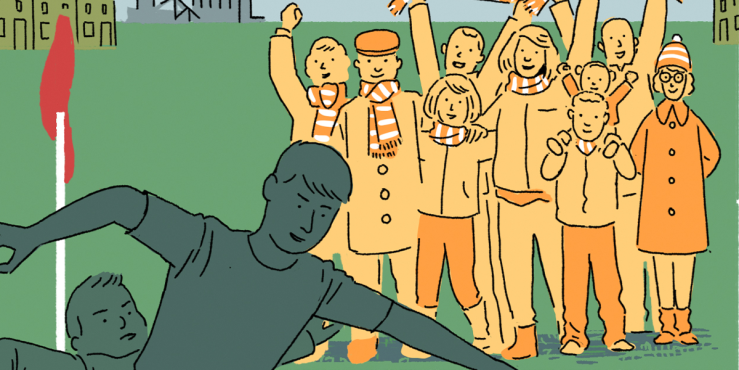
For the Independent Football Regulator, heritage is about kits, badges and stadiums. Postgrad researcher Joshua Bland (Department of Archaeology) reckons it’s protecting the wrong things.
For the Independent Football Regulator, heritage is about kits, badges and stadiums. Postgrad researcher Joshua Bland (Department of Archaeology) reckons it’s protecting the wrong things.
The new Independent Football Regulator (IFR), which assumed its full powers in December, has been described by its chief executive Richard Monks as a “new era for football governance”.
Its aim is to protect and promote clubs’ financial sustainability, make provision for the distribution of revenue received by organisers of football competitions, and safeguard the heritage of English football.
Because I come from a heritage studies background, it’s this last element that I find particularly fascinating, and where I think we need to think more deeply. In IFR terms, heritage is about protecting physical things such as kits, badges and stadiums.
However, I believe football heritage is about much more than physical manifestation. It’s about inter-generational tradition and chains of continuity.
We need to focus on protecting those. Heritage allows us to explore why football means so much to so many people, and a recent project I carried out focused on three radically different clubs in the north-east: Newcastle United, Grimsby Town and Horden Community Welfare FC.
There are many ways to engage with the game, but the traditional supporter sets the cultural tenor, and that’s where I began.
Even if they don’t have an actual financial stake in the club, there’s an awful lot of stress, sacrifice and emotional labour that goes into football supporting.
Morally, supporters feel the club is ‘theirs’. Certain elements stand out from my research. One is that football supporters at all levels experience football through the lens of community. They feel they are in a community of supporters with a series of shared behaviours and traditions, and that’s what makes the community real.
Then there’s identity. In Newcastle, football has replaced industry as a means to define what it is to be a Geordie.
Whereas locals have traditionally looked to the city’s manufacturing industries to forge a sense of self, in the absence of Newcastle’s industrial base, the football club has emerged as the space where locals can establish and perform their sense of civic identity and local pride.
In Grimsby, the stands at Blundell Park have replaced the old community spaces and social bonds once provided by the fishing industry. But Horden Community Welfare is perhaps the most extreme example. Horden was a pit village of 15,000 that now has a population of 7,000.
The loss of the pit threatened an entire way of life. Social protocols, cultural norms and duties of care to a wider community collapsed. But the football club keeps alive that community-focused practical consciousness.
The club is fan owned and operates like a social co-operative with after-school training and partnerships with food banks and mental health charities. It’s one of a series of ad hoc institutions that provide a sense of civic infrastructure in Horden.
In all these cases, football provides a thread between lives and generations; it offers continuity against a broader context of discontinuity caused by deindustrialisation.
Modern football was created in the industrial period, and there is a powerful story of a town born for industry with the football club remaining after that industry falls away.
Football provides a sense of cultural resilience and security – the meaning of football comes from that continuity.
When I talk about continuity, it’s not a benign thing that simply exists. Fans work at it and add layers of meaning. It is deliberate, and that’s what makes it meaningful.
A fan is happy if their team is winning but their sense of heritage is just as important.
This gives policymakers a powerful vocabulary for talking about what football does.
Fundamentally, football support is performative, with the ritual of putting on the club shirt, gathering in pubs and stadiums and singing together. That’s where the badges and kits take on salience.
It’s not a mistake to talk about those things as heritage, but it is a mistake to reduce heritage to those things