
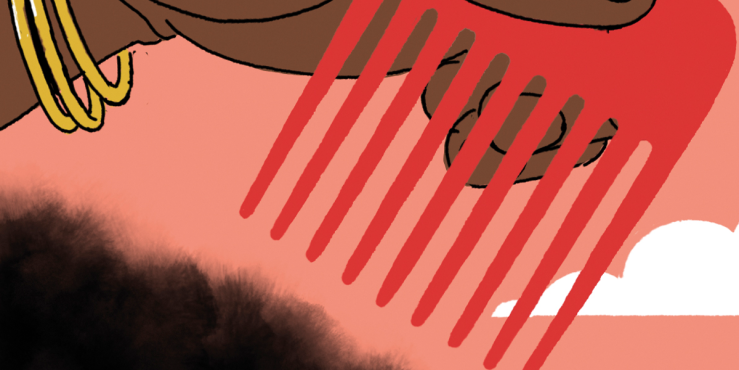
There’s much more to hair than pure aesthetics, says Karen Dominguez Mendoza, PhD researcher at the Centre of Latin American Studies.
On my 15th birthday, like many Latin American girls, I celebrated with my quinceañera – a party that’s effectively a modern ritual of womanhood. And a key part of the day was treating my hair. I grew up in a mixed-race family, and I’m the only one with ‘kinky’ hair.
When I was young, my mom loved it, but didn’t know how to manage it. In racialised social orders, having straight hair is perceived as more attractive and more professional.
But the attempt to relax my hair at that quinceañera went badly wrong.
My scalp was burned and the following hair loss was appalling. And that awful experience began my journey into how Black haircare functions as a form of resistance. It made me realise such expectations are another form of violence against Black bodies, in societies which force us to see our hair as undesired, as ugly, as having no value.
And worse – societies that issue moral judgement.
There’s a phrase in Colombia, pelo malo, meaning ‘bad hair’, which is only applied to Black hair.
Now, if something’s bad, you need to attack it. Language builds realities. As I dug deeper, I came across the Association of Afro-Colombian Women.
They have been working since the 1980s on Black hair as a political tool and a means of identity formation for Black people – women in particular.
With them, I realised this question was so much bigger than just looking after your hair. It was about building community; about intimacy and trust in a space where you’re taken care of – and that’s important for Black people, because care has been stripped from our lives, only conceived as a form of labour – mostly unpaid – that we provide for others.
My research documents stories of resistance from the Black haircare entrepreneurs of Colombia.
These stories matter, because they’re about creating conditions that sustain Black life, and building an economy, both crucial in the ongoing fight against racism. And they matter because it’s essential to understand that the Colombian economy was built on the shoulders of Black people.
These are people that have been misrepresented, overlooked and marginalised. Their stories are missing in the scholarly world, and in journalism and documentary.
What does the Black hair economy look like? It takes place on patios, in courtyards, in living rooms, on pavements, even under trees. And, of course, in the salon and barbershop. From these places springs much more than you might ever imagine. Leadership has been developed in barbershops.
They’ve become a tool for conflict transformation – for example, tackling gang violence in the most impoverished neighbourhoods. Local mayors in cities such as my hometown of Cali are now using barbers as mediators.
The women of the Afro Mata ’e Pelo Foundation, in the northernmost region of Colombia, gathered to talk about haircare discrimination, also founding a shared passion to advocate against child marriage and early union, which isn’t uncommon in their region.
Another group began activism on domestic violence after hearing, during haircare sessions, of members’ experiences.
Writers have emerged from this group, as have entrepreneurs and businesswomen. Hair has become a container to hold many ideas – and a tool for turning dreams into material realities.
People have paid their way through university with the money they make braiding and cutting hair. Knowledge transfer is at the heart of the haircare economy. In the same way, I want my research to reach wider audiences and expand conversations across the global diaspora.
To that end, I’ve filmed a documentary series – telling 16 stories across eight cities – to capture the many experiences of Blackness and Black haircare practitioners.
My hope is that it disseminates their knowledge, and allows us all to be seen in our humanity. Black haircare supersedes aesthetics. It’s about politics and economics.
It’s about resisting helplessness and opposing the normalisation of suffering and violence for Black bodies. It is about care and joy, and building a life that’s worth living.