
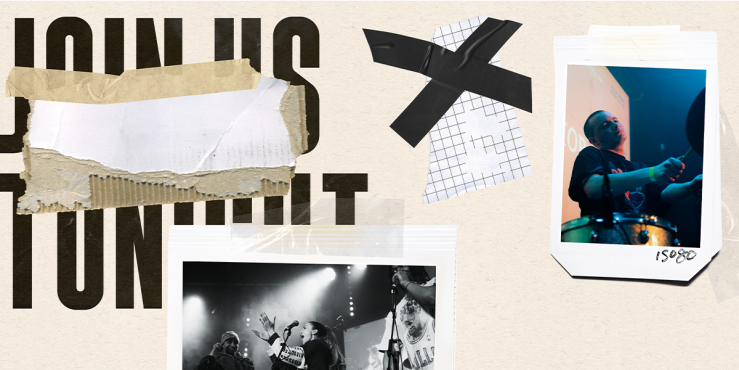
Drummer needed, Dancers req for music video, Sax wanted! Read on to find more about... Flashband.
Disaster. You lug your guitar back to College only to find that your singer is interning at McKinsey. Your bassist is somewhere in Thailand. Your drummer has joined a contemporary dance troupe at King’s. And you? You still dream of rocking out in Clare Cellars. Or even… The Junction. So what do you do? You go to FlashBand – and make your dreams come true.
When Matthijs Duursma (Lucy Cavendish 2024) came up to Cambridge, he managed to convince his father to drive all the way from Amsterdam with a car packed mostly with the paraphernalia of a music obsessive.
“I had a Nord electric keyboard, all my records, some speakers from the 1970s that belonged to my grandparents, and some synthesisers – as well as everything that goes with it, monitors, mixing panels and a little drum machine,” he says.
“It filled the whole car. Dad thought I was mad. I was just happy we didn’t get checked at customs.”
But despite lugging everything across the North Sea, in his first term Duursma was so focused on meeting people, playing sports and his MPhil in the ethics of AI data that he didn’t actually get to play much music.
Until, that is, he heard about FlashBand. “It was exactly what I was looking for,” he says.
“I knew I wanted to start a band, I knew what kind of music I wanted to play – but I didn’t know how to reach people.” FlashBand, created by the Centre for Music Performance (CMP), is a social event with a difference.
You rock up, chat to strangers – and then find yourself grouped, loosely, by your preferred genre and left together in a room stocked with musical equipment.
That’s just the beginning: FlashBand is really a jam session for total strangers; an exercise in group dynamics; an after-hours encounter where you might just meet your creative soulmate.
“It’s often the case that you drop a pebble and the ripples go in all sorts of directions,” says CMP Director Simon Fairclough (Christ’s 2002).
“That’s the beauty of FlashBand; a little bit of structure has a lot of impact.
We’re now in our third year – two events are held in Michaelmas Term and another at the start of Lent – and it’s a fantastic way to break down some barriers and get people playing together.
I’m also convinced that it will spawn some successful bands.”
That certainly seems to be the case so far, with plenty of students having not only found it a great way to settle into university life, but also help fulfil their musical ambitions.
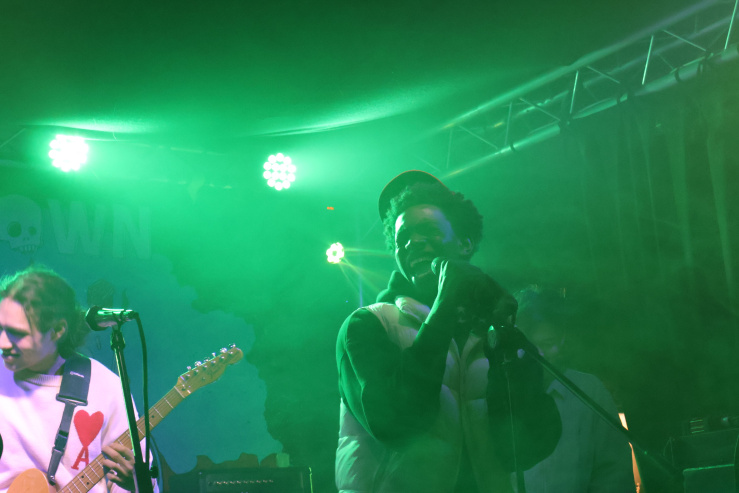
Lost Projects at the APPS Showcase in the Six Six Bar, Feb 25.

Some have formed bands that have performed at May Balls, and even in some of the city’s best-known music venues such as the Corn Exchange and the Junction.
“The night itself was a bit chaotic – but in a really good way,” says Valentina Schutze (Newnham 2024), whose band was formed on the back of a FlashBand session.
“We were all a bit nervous that first night, and were just improvising bits and pieces. But then we stayed around after and chatted, and because we were all warmed up to each other it was easy to find affinities.
“We all wanted to have a bit of a jam after, but one person specifically said: ‘I want to start a band,’ and we talked about the sort of playlist we liked and enjoyed, and that was the start of the band.
Ultimately it was a bit short-lived, and we went our own way after graduation, but it was great while it lasted.
FlashBand made me realise that if I did want to join a band, I had a lot to learn.
But I was still very excited about it and determined, and I was just curious.
I wanted to make music with a lot of people.
Schutze’s band may not have survived the rigours of the industry, but it undoubtedly benefited from the injection of fresh inspiration, something Will Duckett (St John’s 2024) discovered from his night at FlashBand.
“There are different rooms running at the same time, and you move around throughout the evening,” says Duckett.
“As you start playing, you can pick up on who’s your kind of person. In the first room, I didn’t really find too many people, but in the second one there were a couple of people that I really gelled with. You realise you’ve mentioned certain songs that you like, and they like them too, and then you’re exchanging numbers and you’re off.”
Duckett had experience of bands and university band societies beforehand, but says he found the challenge at Cambridge was finding people into typical, traditional bands – electric guitars, keyboards and drums.
And that’s something that CMP’s Fairclough is keenly aware of.
“The classic Cambridge soundtrack – the one that most people think of – is the College choir,” says Fairclough.
“They are wonderful and we’re incredibly proud of them, but we were conscious that there are lots of other students who are interested in other forms of music which were less well supported here in the past. They might have played at a very high level before coming to Cambridge, but they didn’t have the opportunity to find fellow musicians and form communities in the same way. So we wanted to do something very simple and practical that could connect people across Colleges.”
The CMP has a wide and eclectic remit, embracing highly skilled musicians as well as absolute beginners.
They cover all forms of music, with classical playing an established and treasured part alongside popular forms and music from different countries.
“CMP plays a unique role in the Cambridge musical ecosystem,” says Fairclough.
“And we’re able to take a very broad view of what music can mean.”
He gives an example of how the team were approached by a professor who wanted to see if there would be any interest in Indian classical instruments, and he’s proud of the fact that the Indian Classical Society – which grew out of that enquiry – now has 150 members and sells out auditoriums.
“The sheer quality of talent involved is so impressive,” says Matt Fincham (Emmanuel 2002), music editor at BBC Radio 1

Lost Projects at the APPS Showcase in the Six Six Bar, Feb 25
So as well as FlashBand, there are also initiatives like the Advanced Popular Performance Scheme and two out-and-out popular music talent contests: Hook, Line and Lyric is a biannual event for songwriters; and Take it to the Bridge runs yearly and focuses on live performance of popular music.
“The sheer quality of talent involved is so impressive,” says Matt Fincham (Emmanuel 2002), music editor at BBC Radio 1 and a returning Take it to the Bridge judge.
“It’s still quite a new competition, but it’s brilliant that the winning students are getting access to people in the music industry and that they’ve had the opportunity to play alongside some very acclaimed artists.
It would be great if one day it was the same kind of pipeline for musical talent as Footlights has been for comedy.”
Iona Luke (Magdalene 2022) won this year’s Take it to the Bridge.
“The win made me feel really confident and gave me some validation at a time when I really needed it,” she says.
“I’d spent my whole time at university planning for a music career and, as I got closer to graduation, I was thinking: ‘Am I actually going to do this? Am I going to commit?’” Luke and her band hadn’t expected to win.
She had only learned to play the guitar two months beforehand, having previously focused on keyboards, and put the band together even later than that.
“We thought we had no hope,” she says.
“But I think our shock made winning so much better.”
That May Week, they played nine gigs – a combination of Luke’s original material and well-chosen covers.
By the time May Week rolled around for Matthijs Duursma, he was on the move again with his musical equipment, although this time he was navigating Cambridge’s cycle lanes with his synthesiser strapped to his bike.
“I mean, I’m Dutch, I’m used to cycling, but it was still quite tricky when you add in stands and everything else,” he says.
His night at FlashBand was a unique introduction to the city’s music scene.
He would go on to start his own band, and eventually join 2024’s Take it to the Bridge winners QUASAR, a student band who blend jazz and hip hop and who had been booked for 12 separate gigs in May Week.
“Sometimes we would do three balls in one night, which was amazing but exhausting,” he says.
“Then we played the Corn Exchange on the evening of my dissertation deadline.
It was all completely wild. But the music scene here is something to treasure and cherish, and I just hope it carries on in new and exciting ways.”

QUASAR at Junction 11, 1 March 2024 Cambridge Chronicles
QUASAR at Junction 11, 1 March 2024 Cambridge Chronicles

Temor at Junction 11, 1 March 2024 Cambridge Chronicles