
Don’t let its dreadful smell put you off – the Botanic Garden’s star attraction is part of an international effort to conserve rare and important plants.
Don’t let its dreadful smell put you off – the Botanic Garden’s star attraction is part of an international effort to conserve rare and important plants.
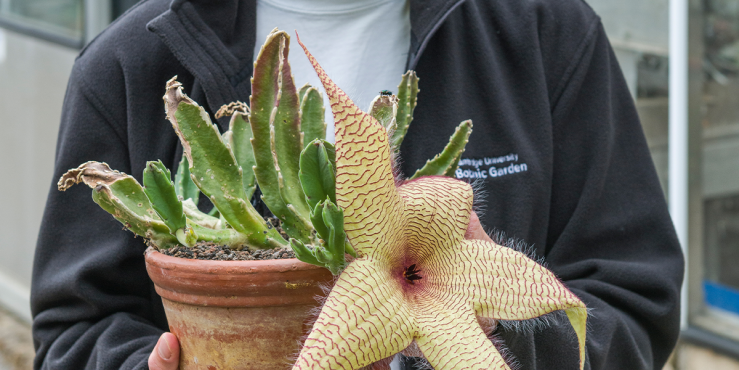
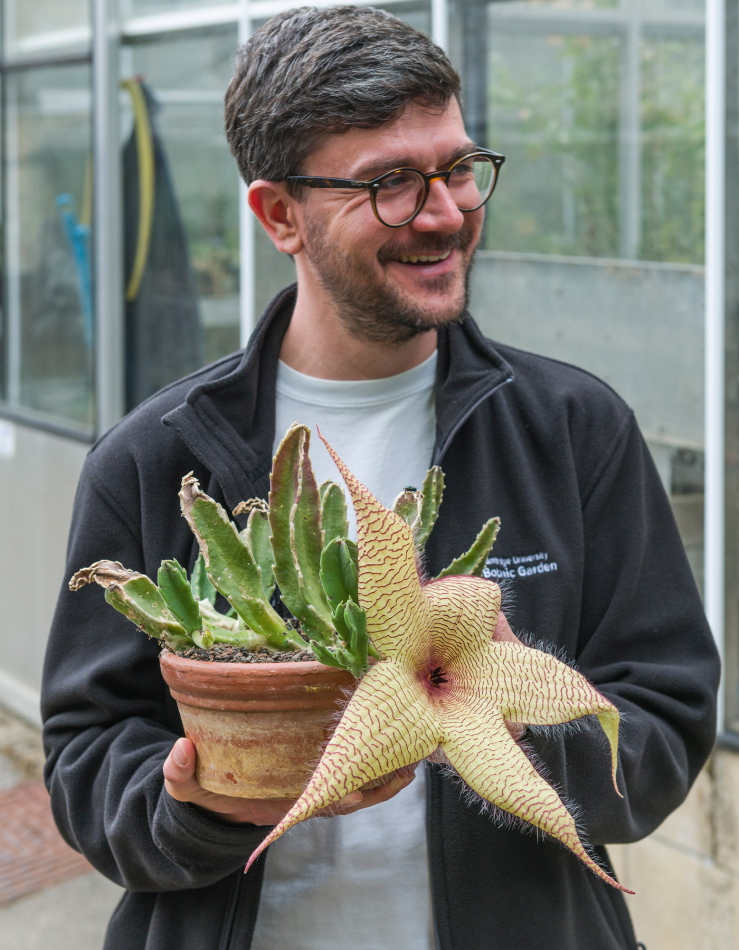
It looks like it could be from another planet, is covered in hairs that resemble a mammal and – there’s no polite way to say this – it absolutely stinks.
The Stapelia gigantea plant, also known as the “carrion flower” because it gives off the smell of rotten meat, is the largest flowering member of the stapeliad group of the Apocynaceae (or dogbane) family.
Native to South Africa, the Stapelia uses its stench to attract flies for pollination, convincing them so well that they even lay their eggs in what they think is its deliciously decomposing folds.
It might not be attractive, but the smell, along with those veiny hairs, are what have guaranteed the Stapelia’s survival – and what make it a star of the Cambridge University Botanic Garden’s living collection.
“South African succulent plants in particular are valuable, because the landscape and climate are varied, with specific rock types, soil geology and rainfall patterns,” says Expedition Botanist Matthew Jeffery.
And he should know: his unique role at the Botanic Garden involves organising and leading globetrotting expeditions to collect and observe wild plants and seeds.
“There are many niches for rare and unusual species to grow and, because of their rarity in the wild, they are very vulnerable to extinction due to poaching,” he says.
“Like many succulents, the Stapelia is particularly vulnerable. People want new and exciting rare things, and poachers can sell plants and cuttings.”
Photography by Howard Rice
This means botanical gardens like Stellenbosch University Botanical Garden, with whom Cambridge has established a partnership, are in a race to find these niche outcrops.
“Stellenbosch staff collect data, monitor plant populations and collect cuttings and seeds of rare plants for conservation and restoration purposes,” says Jeffery.
“They’ll then start to produce them for replanting, and to actively share with other botanic gardens.
“We work jointly with Stellenbosch on improving each other’s plant collections, research avenues and advise each other on collections management, horticulture and education in botany.”
The two universities are now collaborating closely, data sharing and swapping ideas for collection management, as well as working together to study orchids and bulbs in particular, and bring back seeds and herbarium (pressed dried plants) specimens.
Overseeing the pool of global botanic garden living collections is Botanic Garden Conservation International, a charity that gives botanic gardens accreditation, encourages partnerships and keeps a collective data set.
“Our partnership with Stellenbosch allows Cambridge to participate in ex-situ conservation of South African plants, and grow a representation of the South African Cape flora,” says Jeffery.
“The more plants we grow from different species, genera and families, the better we can support research and learning.
Plants are the basis of most terrestrial ecosystems – the start of the food chain. We need them for food, medicine and oxygen, so no matter how much they smell, it’s vital we do all we can to look after them.”
This research is dedicated to Dr Donovan Kirkwood, curator of the Stellenbosch University Botanical Garden, who devoted his life to the conservation of South African plants.