
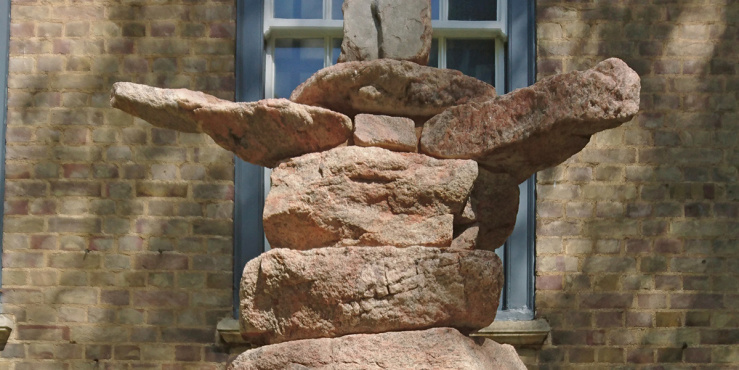
The Scott Polar Research Institute is home to the largest public collection of Inuit art, a fascinating insight into this traditionally nomadic indigenous culture.
Standing sentinel outside the western entrance to Cambridge’s Scott Polar Research Institute is a pink granite inuksuk – a set of rough stones stacked in the shape of a human figure – originally created by Inuk artist Aqjangajuk Shaa in Canada in the 1960s. But the inuksuk is not just there to evoke the Polar environment: in fact, it’s part of the UK’s largest public collection of Inuit art, housed in the institute’s Polar Museum, and a fascinating history of a vibrant indigenous culture.
The inuksuk was donated to the museum in the 1970s, part of a collection of Inuit art created by traditionally nomadic people based predominantly in northern Canada, Greenland and Alaska. And some of the oldest pieces in the collection – such as a number of walrus ivory carvings dating from the late 1800s – are on a completely different scale to the inuksuk, as Dr David Waterhouse, curator of the Polar Museum, explains.
“If you were moving your camp to follow caribou or wild fowl, you wanted small pieces you could take with you – things that were useful as well as beautiful, like carvings on spoon handles,” he says. However, the majority of the museum’s collection – acquired through donations, purchases directly from Inuit artists and the occasional new commission – is from the 1950s onwards, when a community of Inuit forced to settle in Kinngait, a hamlet on Canada’s Dorset Island, turned to soapstone carving.
“As a material, it was cheap, quick to come by and soft enough to carve easily,” says Waterhouse.
The works feature beautiful portrayals of Inuit mythology. There are dancing owls, polar bears standing on one leg and various mythological beings – including Waterhouse’s personal favourite, a figure of the Inuit sea goddess Sedna, who is half-human, half mermaid. She’s usually depicted without her fingertips – legend has it that these were cut off and transformed into sea creatures.
Alongside the carvings, the collection houses prints, paintings and drawings. With support from the Heritage Lottery Fund, it has grown to include works by some of the most important figures in the modern Inuit art world – in a wide variety of styles and formats – from almost every producing community in northern Canada, as well as smaller collections of works made in Greenland and Alaska. For Waterhouse, displaying these artefacts is about more than preserving memories of the past.
“We want to include modern Inuit art to ensure the collection continues to keep up with what is happening now,” he says, citing a bomber jacket designed by the indigenous artist Inuktrini as an example of a recent acquisition. The next step is to get more pieces out of storage and on public display, as well as to co-curate future exhibitions with Inuit participants.
The Polar Museum is also currently working with an Alaskan Inuk consultant on an innovative new Indigenous Engagement Policy, establishing a framework by which to engage respectfully and meaningfully with indigenous Arctic communities. As Waterhouse says: “The more we work in partnership, the better.”
To find out more, visit the Polar Museum at https://www.spri.cam.ac.uk/museum/