

Languages are the world’s repository of memory and knowledge – and are crucial for establishing our place within it, says Professor Charles Forsdick.
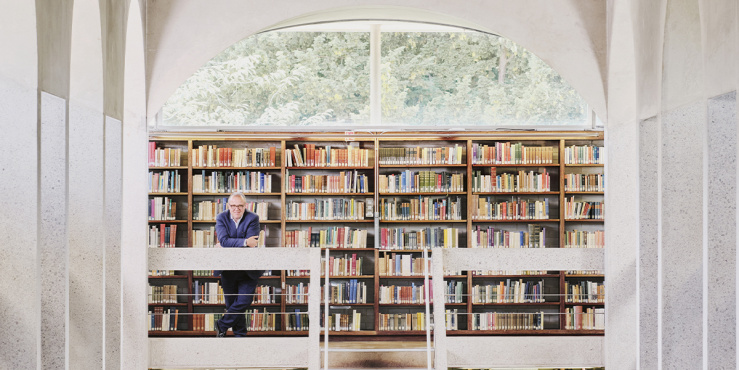
Renowned modern linguist Professor Charles Forsdick has one big fear: that learning languages is under threat in the UK.
“Championing different languages is important for a nation’s global position, as well as its knowledge, memory and even public health,” he says. The modern linguist starts with language, but they are really interested in the translation of ideas, in translation as driver for the exchange of cultures and ideas. “Languages carry with them a cultural, social and political subconscious – it’s the hinterland of thought and memory that resides in language that’s interesting.
Yet in this country, language learning is under threat – from populism, technology and a ‘monolingual mindset’ that risks leaving us all poorer and more isolated.” The son of two language teachers, Forsdick’s own fascination with language was perhaps inevitable – “I grew up in Norfolk,” he explains, “which has a reputation for being monolingual and monocultural (and flat!). Languages were exotic. They were a passport out.”
But it wasn’t until a year out in Brittany that his future was set. Deep in a Finistère forest, he came across a monument marking the place of death of naval doctor and author Victor Segalen in 1919. He researched the name and was immediately fascinated by this polyglot traveller and exhausted opium addict, who had written beautiful poetry in both French and Chinese. After a French degree at Oxford, Forsdick’s PhD at Lancaster University focused on Segalen. “He travelled to Polynesia at one stage, and you can see the exoticism of that period coming through in his writing,” says Forsdick.
“My passion was travel writing, but I was interested in how French was translated into the radically different culture of Polynesia, and I became drawn to other Francophone countries and regions. French is a global language and shouldn’t be reduced to France. Haiti is really interesting, for example – the Haitian Revolution happened at the same time as the French Revolution. Haiti was a French colony for 300 years, but has been independent for 220.” Forsdick’s doctorate swiftly led into a lectureship at Glasgow, and then Liverpool, where he would remain for 22 years.
It was here that he became interested in the history of slavery, co-founding the Centre for the Study of International Slavery and taking part in reparations debates. It was also here that he co-founded the Reggae Research Network. “In the 2010s, I was teaching translation studies, the idea that travel is a kind of translation, and examining the new cultural forms that emerge from people moving around the world – as they translate cultures. Reggae is a form of music that is translational in origin – between anglophone and Caribbean cultures – and I find that truly fascinating.”

Now Drapers Professor of French within the Faculty of Modern and Medieval Languages and Linguistics, as well as Lead Fellow for Languages at the British Academy, Forsdick has his sights set on the threats to our modern perception of language.
“Modern languages are not just about the acquisition of language, but can also be about the circulation of ideas.
We can see that in the history of medicine and how bodies of knowledge can travel. We forget that our medical knowledge – of physiology, cardiology, the body and wellbeing – came from North Africa and the Middle East in the 12th, 13th and 14th centuries, when thinking in those places was far more advanced than us. That knowledge arrived through translation and transformed our culture.”

Confident in the current status of English as the world’s lingua franca – which history would suggest is a temporary state – he says we overlook other languages at our peril.
"GCHQ and the Ministry of Defence share this view, as I know from working with them. They understand that we need to cultivate home, heritage and community languages in the UK as a natural resource, because being able to communicate multilingually is strategically important.
Imposing English alone is a mistake and can squander our global advantage in terms of knowledge.”
Take Covid. At the start of the pandemic, he says, the medical knowledge was in China, and therefore in Chinese. If you couldn’t translate it, you couldn’t understand the epidemiology.
“And then, when we developed the vaccines, we had to make sure information about them was translated into multiple languages. There was a perception that the solution was biomedical, but the arts and humanities, including languages, were crucial in ensuring trust in and adoption of vaccines – not just for reaching different audiences but understanding how to communicate with them.
“We also saw increased interest in literature relating to disease and confinement – such as Camus’ La Peste and Xavier de Maistre’s Voyage Autour de Ma Chambre.”
And, of course, one popular lockdown activity was hit language app Duolingo. But this curiosity and appetite for languages among adults is not translated into valorising formal language teaching in the UK, Forsdick says. And indeed, for language learning, technology can be a double-edged sword. “We can see culture circulating in the increase in popularity of Korean culture due to the Netflix series Squid Game, for example. But, in other ways, artificial intelligence like Google Translate can make us think: ‘What’s the point of learning a language in school?
We can just use Google Translate.’ In reality, using a translation app can be a frustrating experience. Partly because it needs human validation for any nuance, but also because it can amplify the experience of language as a barrier.” Alongside technological advances, we have also had Brexit, and the rise of populism.
“It’s social fact that the UK has always been multilingual,” says Forsdick. “We have Welsh, Gaelic and BSL, and English itself is a creole of French. Yet Brexit carries an ideological monolingualism, hypocritically, because some of its advocates were multilingual but projected themselves as monolingual. It breeds linguaphobia, a denial of our own multilingualism.
“What we need instead is a change in policy in language teaching, one that recognises that in our major cities we have super-diverse classrooms where 20 or 30 languages might be spoken.
And we could see this as a strength and a national resource, instead of pathologising it. Those bilingual pupils are already agile linguistically, so it’s an academic strength. And languages have always been part of our Britishness and our citizenship, they are not something exterior to us.
They’re not exotic or a threat – they’re a part of everyday life for children in Britain today, either speaking them or being surrounded by them. Speaking other languages doesn’t mean English suffers, and it helps us understand our place in the world. “The National Curriculum currently requires substantial progress in a single language at primary level, but we could also move to encouraging a multilingual mindset, where we teach a rudimentary understanding of how different languages work, as a part of cultures, and build curiosity up to Year 6, then move to a choice of languages in secondary school. This might also help challenge the perception of language learning as being difficult. If we don’t value and celebrate language learning, not only might we lose our language capabilities – we also risk closing our minds.”
The Year Abroad
The Year Abroad is a distinctive and foundational element of the Modern and Medieval Languages and Linguistics (MMLL) tripos.
It provides students with a unique opportunity to be fully immersed in the cultures and languages they study, gaining valuable life experiences as well as professional skills and networks that benefit their future lives and careers. We need support to ensure that future generations of Cambridge students, regardless of background or circumstances, can have equal access to transformative experiences.
If you are interested in supporting the Year Abroad, contact kara.rann@admin.cam.ac.uk. Or for more information, visit our MML Year Abroad Fund page.