
Half the sky. Billions of objects. In six colours.
Half the sky. Billions of objects. In six colours. The Legacy Survey of Space and Time, which begins this year, promises to deliver the first motion picture of the universe, answering some of the most pressing questions about the structure and evolution of our world. But while the questions the LSST addresses are profound, the concept is remarkably simple: conduct a deep survey over an enormous area of sky to create astronomical catalogues thousands of times larger than previously compiled.
This summer, filming begins – with a stellar cast – on a movie that promises to tell the greatest story of all time. But this is no ordinary project. For a start, there is no director. There will be no cinematic release. And the script isn’t finished…
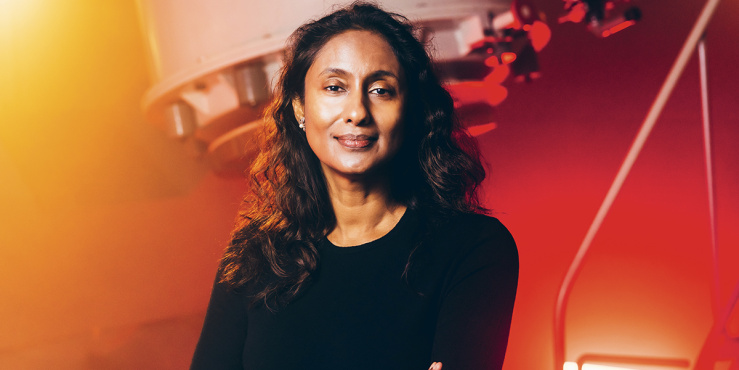
In fact, the Legacy Survey of Space and Time (LSST) is one of the most ambitious projects in the world of astronomy: a mission to capture a moving picture of a billion galaxies, with images of half the entire sky captured every three days over a period of ten years. It promises to provide answers to some of the most pressing questions about the structure and evolution of our universe, including whether dark energy exists, what dark matter is made of, and the ultimate fate of our cosmos. And the Professor of Astrophysics (1909) at the Institute of Astronomy, Hiranya Peiris (Murray Edwards 1994), is playing a starring role.
“Surveys are one of the most fundamental tools we have in cosmology,” says Peiris.
“A survey is blindly looking at the sky in a representative way so that you can make statements about the evolution of the universe.” But this particular survey, dealing as it does in such a vast torrent of data, requires a step change in analysis techniques. Until recently, astronomers would spot rare events such as supernovae by comparing images taken at two different times and using human expertise to tell the difference between an exploding star and image processing artefacts.
Now that time-consuming process will be handed to machine learning algorithms, but to train them, Peiris and collaborators have created highly realistic simulations using all the known classes of objects in the universe, adding frequency and instrumental noise, to create fake LSST data sets.
She and colleagues then ran a machine learning challenge through Kaggle, the data science competition platform and online community for data scientists, to stimulate the creation of algorithms that solve this big data challenge. As well as using machine learning to classify objects, Peiris is using a technique called forward modelling to try to understand which model of the universe is the right one.
“You can realise many mock data sets with different underlying assumptions about how galaxies react with dark matter, and then you compare these fake data sets to the real data to work out which model matches the observed universe,” she says.

And it’s not just the datasets that are on a grand scale. Shooting this epic has required the development of the largest digital camera ever built.
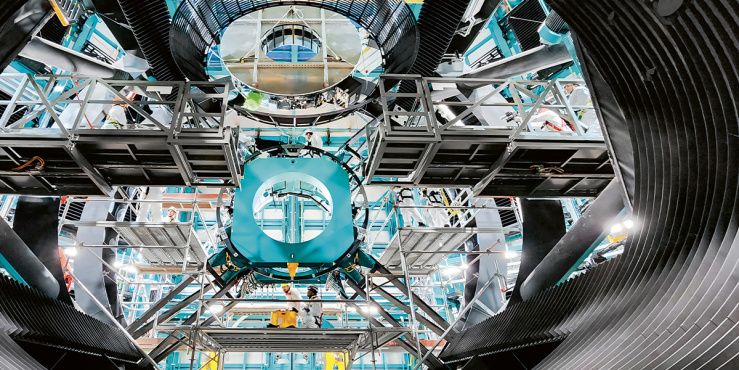
The LSST’s camera features a resolution of 3.2 gigapixels, measures 3 metres long and 1.65 metres wide, and weighs in at 3,000kg. The camera is attached to the 8.4-metre mirror of the Simonyi Survey Telescope, which sits inside the Vera C Rubin Observatory in northern Chile (named after the pioneering American astronomer who revolutionised the understanding of dark matter).
And the view from the top of the 2,682-metre El Peñón peak will be of sparkling clarity, with images taken using a set of six rotating colour filters across the entire visual spectrum, but also extending slightly into the ultraviolet and the infrared.
The result is a ‘wide, very deep and fast’ astronomical survey that builds on the pioneering work of the Sloan Digital Sky Survey (SDSS) – advances in technology mean that LSST will be able to reach the depth of observations made by SDSS over its 20-year lifetime in just three days.
By looking at the same parts of the sky every three days, Cambridge’s astronomers will be able to capture rare events such as stars going supernova or signposts of compact object mergers, where stellar remnants such as black holes and neutron stars collide, sending the ripples of gravitational waves out across the universe.
For Peiris, it’s the latest giant leap in a lifelong love of astronomy that began early – as a five-year-old in Sri Lanka watching Carl Sagan’s landmark television series Cosmos. “I was blown away by the vastness of the ideas and the sweep of time and space,” she says.
Her father then brought her back a small telescope from a trip to the UK to take advantage of Sri Lanka’s dark skies through which she saw the moons of Jupiter and Saturn’s rings. She also began reading science fiction novels, particularly those of visionary writer Arthur C Clarke who also lived on the island at the time. “I was in the Young Astronomers’ Association, and he was patron of that,” says Peiris.
“He had a library of classic movies in his house which he used to lend to us. The first time I saw 2001: A Space Odyssey it was his copy.” Roll forward to Cambridge, where Peiris got an opportunity to work at NASA’s famous Jet Propulsion Laboratory on the Galileo mission as an undergraduate intern, prompting a career switch from computer science to physics.
Later during her PhD at Princeton University, she also worked on what Professor Stephen Hawking called “the most exciting development in physics during my career”: the Wilkinson Microwave Anisotropy Probe (WMAP) collaboration. This collected data on the cosmic microwave background radiation that is the cooled down signature of the Big Bang.
“WMAP had enough power within its observational capacity to look at different ingredients in the universe all at the same time in a comprehensive way. That clarity allowed us to put together a picture of the universe and this picture was really bizarre,” says Peiris.
“I was blown away by the vastness of the ideas and the sweep of time and space" - Professor Hiranya Peiris

Cosmology is multifaceted – we have many different tools to try to work out what dark matter and dark energy are. The difference with LSST is that we are going to leverage them all at the same time.
Emerging from WMAP’s observations was the now widely accepted Standard Model of Cosmology. This says that most of the contents of the universe are not composed of atoms, but rather dark matter and dark energy. “We also found evidence that everything in the universe could have originated in quantum fluctuations in the first instants of the Big Bang,” she adds.
On returning to the UK, Peiris worked on the analysis of data from the European Space Agency’s Planck Collaboration, which confirmed WMAP’s results and measured the parameters of the standard model of cosmology precisely. This brought her to work on the LSST, and while the project’s ‘first light’ images were revealed in July, the first academic findings into what those pictures mean will probably come as soon as next year.
“The time it takes to make cosmological statements that blow the current constraints out of the water is actually quite rapid. After about two years, I imagine we will be able to go beyond the state of the art,” she says.
But how can a camera designed to take pictures in visible light help cosmologists better understand dark matter and dark energy which, by their very nature, cannot be seen?
One of the methods being used by LSST to understand dark matter is gravitational lensing. We know from Einstein’s theory of gravity that mass bends light, and galaxies in the universe trace an underlying scaffolding of dark matter that we cannot see. So, if there is a cluster of galaxies (full of dark matter) in the foreground and a galaxy in the background, the light from the background galaxy gets distorted or ‘lensed’, often creating distinctive arcs or circles of light around the foreground galaxies, sometimes containing multiple images of the background galaxy.
But in cases where the lensing is not so extreme, the shape of the galaxy is very slightly distorted and its image displaced. Multiply that by the billion galaxies that LSST is going to observe, and you can work backwards to see where the dark matter is and how it is evolving over time.
Insight into dark energy will come from capturing supernovae, the fiery explosions that mark the death of stars much bigger than our Sun. Certain types of supernova appear to have the same intrinsic brightness when they explode, and by measuring the apparent brightness of such supernovae in LSST, astronomers can work out how far away they are. Peiris says LSST may find tens of thousands of gravitational lenses – some of which may also have supernovae going off in them, which could revolutionise cosmology. Such observations may help resolve what is known as the Hubble Tension, a discrepancy in the value of the rate at which the universe is expanding when you use different methods to calculate it.
“A dream of mine is that we discover enough gravitationally lensed supernovae with LSST to be able to calibrate the distance ladder better, with gravity rather than astrophysics, to investigate the Hubble Tension,” Peiris says. “Cosmology is multifaceted and we have many different tools at our disposal to try to work out what dark matter and dark energy are.
The difference with the LSST is that we are going to leverage them all at the same time within the same amazing dataset.”
As well as looking far out into the universe, LSST will also be making movies closer to home. “We will also use LSST to make an inventory of asteroids in the Solar System,” says Peiris, “and in particular to provide an early warning system for asteroids that might collide with the Earth in the future.” Hollywood has already made that movie, but the latest release from the LSST looks set to break all records – and run and run and run.