

Americans who come to study at Cambridge stand on the shoulders of giants, but what is it really like to follow your dreams over an ocean to a world of ancient buildings and supervisions, bops and bedders? And what happens next?
Thomas Nelson, Founding Father (Christ’s 1758). Robert Oppenheimer (Christ’s 1924). Ray Dolby (Pembroke 1951). Milton Friedman (Caius 1954). Sylvia Plath (Newnham 1955). Henry Louis Gates (Clare 1973). Tara Westover (Trinity 2008). Kayla Barron (Peterhouse 2010). Anna Malaika Tubbs (King’s 2017). Americans who come to study at Cambridge are in exalted company, but no two experiences are the same.
So what is it about the ‘special relationship’ between Cambridge and the US that creates such incredible opportunities? Bill Janeway (Pembroke 1971) says things didn’t quite turn out as expected. Returning to his native US, in the final stages of a Cambridge Economics PhD, he assumed that he’d become an academic economist.
But the America he returned to was not what he was expecting. “There was a schism in economics at the time, especially between Cambridge and MIT – and MIT’s neoclassicist Paul Samuelson won out,” says Janeway. “I had assumed I would become an economics professor in the US, but that meant teaching Samuelson, and I couldn’t do it. I interviewed at four top US universities, but while there were jobs, they were all the same jobs, so I wandered into old Wall Street, where there were hundreds of private partnerships.
There I had the good fortune to join a firm whose reason to exist was fundamental research on the science-based industries.
“This led me to the computer industry, where my work as an investment banker for emerging companies evolved – after I joined Warburg Pincus – into direct venture capital investing. Making decisions informed by what I’d learned at Cambridge, I then found myself, 10 years later, managing a portfolio of software startups – two of which were strategic to the commercialisation of the internet, and received amazingly high valuations in the great tech/dotcom boom.”
However, his Cambridge experience was about to intervene in another life-changing way. Janeway had originally wanted to go to Cambridge because of interventionist economist John Maynard Keynes – “I was very taken with his recognitions that economic and financial decisions are made in the face of inescapable uncertainties” – and embarked on a thesis using previously unseen documents about the 1929 Labour government charged with confronting the Great Depression.
Now, because of that thesis, he knew how the online boom would end. “I liquidated my portfolio just before it all burst,” he says. (He would go on to make Cambridge a beneficiary of this financial foresight.)
Janeway, now Chair Emeritus of the Cambridge in America (CAm) Board, claims he was “mainly a spectator” at university, watching, for example, Germaine Greer do a striptease dressed as a nun in one memorable performance of the Pembroke Smokers theatre group.
But he also worked alongside Eric Homberger (Queens’ 1965) and Simon Schama (Christ’s 1964), editing The Cambridge Review.
“We published some interesting things, such as work by the young poet Sylvia Plath.”
Fifty years on, America continues to change and evolve, but author and educator Anna Malaika Tubbs (King’s 2023) feels her place in that world is just as informed by her Cambridge experience as Janeway’s. “Cambridge has allowed me to become one of the voices who can speak about what we are seeing in America today,” she says.
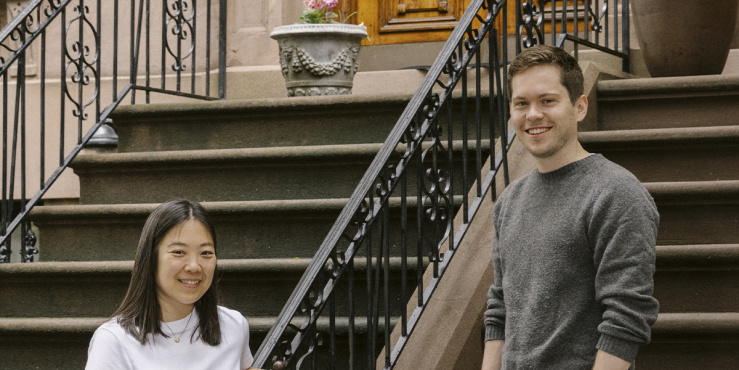
Nancy Yoo (St Edmund’s 2015) and husband Marc Jansen (Downing 2011) by Laurel Golio

Tubbs chose her course in multidisciplinary gender studies because it offered not just women’s studies and literature, but also history and medicine:
“It was the most expansive Master’s I could find in the world.” She also stayed on for a PhD, supported by a Gates scholarship, researching what would become her first book Three Mothers (of Martin Luther King, Malcolm X and James Baldwin). “I feel like Cambridge gave me the space to make my degree my own,” she says.
“Without that freedom, it could have been stunting. The Gates scholarship supports you to do something good for the world, and Cambridge encouraged my activism. I wonder if elsewhere I would have been seen as not ‘academic enough’, as I wanted to write for a broad audience, but my supervisor Mónica Moreno Figueroa always supported me. Cambridge put so much trust in us as researchers, and in our ability to map out our own plan.
My book became a bestseller and I’ve just published my second, Erased, about the American patriarchy.”
Final year student Charlize Boul (Trinity 2025) is still immersed in this world. “My family moved to Bedford, near London, when I was 16, from the North Carolina coast. The ‘Southern hospitality’ cliché is real, and I was as open and chatty as I’d been back home, but the reaction was different. Soon I was wondering: ‘Why does everybody hate me?’! People told me:
‘They’re just getting to know you before they decide if they want to be friends with you,’ and this made no sense to me. Why not start by being sociable?
“It wasn’t the same at Cambridge. No one is normal here! And that’s because they’re so passionate about what they do, they’re so invested in their subject, they’re less polite and standoffish.” Still, there were idiosyncrasies to adjust to in her undergraduate study of Classics. “The plodges, pidges and the gowns – which my family still call my Harry Potter robes. And don’t even get me started on College spouses – how it becomes normal to say: ‘Yes that’s my College wife, we just adopted an Engineer.’
But I’m working it all out: I was in the Bumps last year – I didn’t want to row, but they were appealing for a cox, saying: ‘We need people who are small and loud’, and all eyes turned to me. I was chosen against the odds – I don’t have hand-eye co-ordination except when I’m on a rudder – but I loved it.”
Rowing was one of the main reasons Daphne Martschenko (Magdalene 2019) chose Cambridge, as well as its MPhil in Politics, Development and Democratic Education. She would become the first Black rower ever to compete in the Boat Race, in 2015. But when she arrived at Cambridge, she found the facilities a little different to her previous alma mater, Stanford.
“The Cambridge women basically rowed out of a tiny shed,” she laughs, a little bitterly. “There were no showers or hot water or heating... or even a kettle!” Now Assistant Professor at the Stanford Center for Biomedical Ethics, Martschenko looks back and sees it all as ‘character building’. “If anything seems tough to me now, I think about the fact that I would get up at 5am, cycle to the train station, go to Ely, jog to the boat shed and get started. Often in the rain.
And I absolutely apply the skills I learned every day,” she says. “Those include time management, showing up when you say you will, being accountable, taking criticism and adapting to it. My PhD in bioethics was self-driven, so I learned to advocate for myself, be independent in my work, and pursue my research interests without fear.
My supervisor, Anna Vignoles, was fantastic. She taught me to admit what I don’t know – and have the curiosity to find it out.”

Jasmine Olivera (Jesus 2019) by Laurel Golio
Jasmine Olivera (Jesus 2019)
Jasmine, a corporate responsibility and sustainability specialist, currently lives in Freeport, New York, a coastal town with a diverse population that she says has a similar energy to her hometown of Brentwood, and helps her stay connected to her Puerto Rican roots.
“Bryant Park is at the heart of NYC’s bustling atmosphere. The area features iconic subways that teach New Yorkers a lot of our street smarts, while connecting us to endless culturally immersive opportunities.”

Julien Reiman (Trinity 2019) by Laurel Golio
More amazing stories: Julien Reiman (Trinity 2019)
Originally from Atlanta, Georgia, Julien (photographed on the left) is an Account Director at OpenAI, having previously worked in AI startups, politics and political communications.
He finds meaning at the nearby Chabad West Village – and at the gym, continuing a fitness journey that began with the Cambridge Powerlifting Club.
“The West Village is so quiet and quaint – the only place in New York where I can feel truly at peace – just as the quiet, ancient court at Trinity College was where I felt most grounded at Cambridge.”
“Intellectual excitement”
For CAm Board Vice-Chair Marc Feigen (St John’s 1985), it was the “intellectual excitement” Cambridge awoke in him that shines through now he’s back home – something that persists to this day. A Thouron scholar, he says Cambridge changed his life. “The Thouron rescued me,” he says.
Having spent four years at Penn University – “a pre-professional culture” – the pressure on him to become a lawyer was overwhelming.
“But at Cambridge, I found myself staying up all night debating the existence of God!”
He did one year as an affiliated student reading the History Tripos Part II, and then one year as an MPhil in International Relations, and found a routine where “every day ended with music at Evensong, and every evening began with wine”. Having previously barely left the US, he now met people from all over the world. “It was the sheer brilliance of the people I met that I loved,” he says.
“The intelligence and questioning, the rigour. It’s why I have so many books on my shelves today.” Feigen abandoned the law and went on to counsel businesses to innovate.
“I drew on what I learned at Cambridge, which is that a good theory is there to be challenged. I also learned a universal common humanity – that we all have similar dreams and needs.
After two and a half years at Cambridge, my father told me: ‘If you don’t come home for Christmas, you’re in trouble.’ Later, he would ask: ‘Why are all your friends English?’ But it’s because the friends I made at Cambridge are still my best friends today.”
To keep in touch with fellow American Cantabrigians and find out the latest news, sign up to the Cambridge in America newsletter at cantab.org
As Cambridge in America (CAm) celebrates its 25th anniversary, it continues to promote interest in, and support for, the University among alumni and friends in North America. Since its creation, CAm has served both the University and Colleges in philanthropy and engagement efforts: it raises philanthropic funds for the Colleges and University programmes; engages North American alumni through content-driven networking events and communication; fosters volunteer participation through more than 40 alumni groups and six advisory committees; and ensures that all gifts and donations are appropriately acknowledged and distributed. If you’d like to find out more and get involved, visit cantab.org