
Skipper a patrol vessel in open sea. Climb mountains. Learn to fly. Every year, Cambridge students join one of the three societies affiliated with the Royal Navy, Army and Royal Air Force – often the beginning of a lifelong adventure.
Brigadier Clare Phillips CBE (Robinson 1991) has been deployed to Bosnia, Iraq and Afghanistan, became the British Army’s first female Corps Colonel, represented the Corps of Royal Electrical and Mechanical Engineers at hockey and rugby, and earned herself a CBE. But where did it all begin? At Cambridge, of course.
Towards the end of her second year, Phillips began to wonder what would come next – and was not inspired by what she found at career fairs. “One of my best friends was at Newnham and came back from a visit to Sandhurst where she’d driven a tank, fired a rifle and played a lot of sport,” she says.
“I thought that sounded perfect.” Phillips signed up, spending the Easter of her third year on deployment to Cyprus while her friends were preparing for exams. And that made sense, says Phillips, because when it comes down to it, Cambridge life and Army life are not so different. “The fundamentals are the same.
You work hard and play hard. If you are involved in societies, you learn the fundamentals of leadership and organisation. It encourages you to think about how you conduct yourself. I had been to state school so things like communal living were entirely new to me, and these are very similar to Army life.
Even the exposure to some of Cambridge’s traditions – balls, gowns, dinners – helped me understand what was expected in the Army.” Indeed, for some students, service life is not separate from, but an integral part of, the university experience. While most students are spending another quiet Tuesday evening working on essays, watching telly or sitting in the student bar, you’ll find Hugo Barraud (Selwyn, Third Year) at Coldhams Lane using a virtual firing range, practising first aid or learning how to build a defendable campsite.

As a senior under officer for Cambridge University Officers’ Training Corps (CUOTC), Barraud is part of an organisation run by the British Army to give students a commitment-free taste of military life.
“There are so many great opportunities,” he says. “Ten days ago, I was skiing for the first time in my life, showing the potential of student life.
At the weekend, I don’t have to think about my degree, and I can get out of the Cambridge bubble.
When I get back and talk to my friends about what we did at the weekend, I usually have an interesting story to tell.” It’s a similar story – albeit on a Wednesday evening and this time on the water – for Acting Midshipman Joanna Burgess (St John’s, Third Year). She is a member of the Cambridge University Royal Naval Unit (Cambridge URNU) – the Navy equivalent of CUOTC – having joined at her first Freshers’ Fair, and is now paid to kayak, paddleboard and sail as an official reservist.
“We might do navigation or first aid or learn to cook with a Royal Marine,” she says. “We have regular weekend trips, where we travel down to Sandhurst to go shooting or go to the Norfolk Broads. Recently, I went to Sicily for a conference with people from Ukraine, Canada and Georgia.” The armed forces have a longstanding connection with Cambridge, through these reserve units as well as via nearby military bases.
But it’s not just the British military which is associated with the university. When American student and future F-16 pilot Zach Stiffler (Caius 2019) decided to take up rowing for his College, one of the first things he spotted at the boathouse was a set of oars with the name of John Lehman, a former Secretary of the US Navy, who had been at Cambridge in the 1960s. That planted a seed. After graduating, Stiffler took a break from flying missions with NATO to form the University of Cambridge Armed Forces Alumni Network.
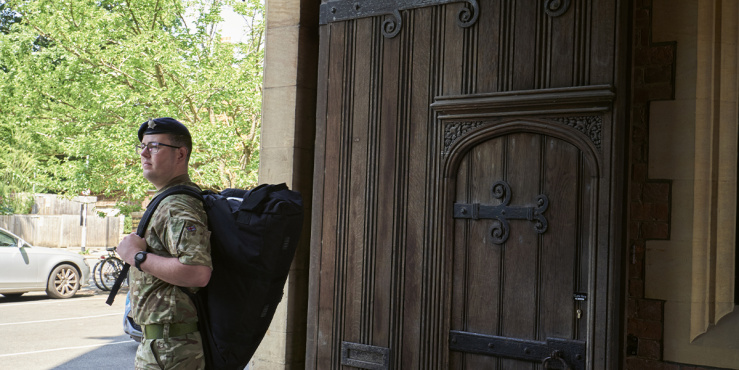
The organisation is open to armed forces members from any time or nation, as a way of sharing memories and experiences
It’s currently online but Stiffler hopes to organise physical meet-ups – ideally back at Cambridge. “I loved my experience in Cambridge – the people, the opportunities, the dinners, the lectures,” says Stiffler. “It changed me as a person. One of the most incredible aspects of Cambridge is how it fosters community and shared learning.
Learning doesn’t end in the classroom. The military has that same approach, so combining the two is pretty awesome.” There are three main ways in which the armed forces connect with the University: existing personnel take in-service degrees to help develop their careers; recruits fresh from school are sponsored to do a degree before joining their regiments full time; and students like Burgess and Barraud join the CUOTC, URNU or the RAF’s equivalent, the Cambridge University Air Squadron.
These units are all drop-in, but participants get paid for their training.
They are supported by the armed services, but without any obligation to join up after graduation – and with the proviso that participation does not interfere with a student’s work. Barraud and Burgess relish the weekend manoeuvres and the longer end-of-year expeditions that take them to distant parts of the UK, as well as formal dinners where they meet more experienced military personnel.
A more recent initiative has been socials involving all three branches of the Cambridge organisations to encourage cross-service mixing. And these are all national as well as local organisations, so students get to meet students who share similar interests across the country. Colonel Jon Lowe (Girton 1996) was already sponsored by the Royal Engineers when he went to Cambridge, but through the CUOTC was able to maintain a military education alongside his academic life and sporting interests (he was a cricket Blue).
It was on a CUOTC exercise that he first discovered the Army Air Corps, with whom he served as a helicopter pilot. Lowe explains that the CUOTC and its sister organisations need to strike a delicate balance – on the one hand providing a meaningful introduction to military life but also competing with so many other University clubs and societies. Which basically means they need to be fun.
“We did weapon handling, map reading – basic military stuff,” he says. “Once a month we’d have a weekend exercise when you’d live out in an Army context, which means being tactical and secure. You’d also use ranges to fire live ammunition. That sort of thing appealed to my friends so I managed to persuade a number of them to join the OTC with me.”
Sir Nick Pope (Jesus 1981) is one of Cambridge’s most distinguished military alumni. He served in Bosnia and Afghanistan, reached the rank of Lieutenant General and acted as Deputy Chief of the General Staff – essentially No 2 in the British Army. He arrived at Cambridge having signed up as a cadet with a pledge to return to the Army upon completing his studies.
After three gruelling weeks of physical training at Sandhurst prior to ‘going up’, he maintained his fitness at Cambridge through hockey, rugby and weekly evenings with the CUOTC. As a member of the armed forces, Pope was at Cambridge on a salary – something that set him apart him from his more impoverished peers.
“You are what is known in military parlance as a ‘one-pip wonder’, but you think you are rich as you are paid to go to university,” he recalls. “You are both a student and a soldier, and it’s about the intersectionality as you switch between the two. We are all seeking comradeship and belonging and for a lot of people, spending every Tuesday evening at Coldhams Lane gives them their tribe, where they get to run around in funny uniforms with their friends and generally have a great experience.” That shared army experience also helped break down some of the social barriers between students, and through the military, Pope – who went to state school – became acquainted with no less a figure than Prince Edward, a couple of years below him at Jesus and a fledgling Royal Marine. “I ended up being his taxi driver for rugby matches,” says Pope.
“We had that military connection, and it was enough to break the ice. The military provides a framework for finding like-minded people.” But there is, of course, much more than relationship building or CV-enhancing on offer, which is what keeps Joanna Burgess coming back. She probably won’t join the Royal Navy when she finishes her degree, but she does intend to remain a reservist for the foreseeable future.
“What really attracts people is that we combine a lot of different activities in one,” she says. “We do hiking, sailing, shooting… a lot of activities but in one organisation. That’s something you can’t find anywhere else. I have managed to persuade a few friends to come to evenings as people are really amazed by the range of things we get to do – and the fact we get paid for it as well. They find it quite fascinating."

The CUOTC, offers students Reserve Officer training modules designed to fit around their degrees, learning everything from how to wear a uniform correctly to the ability to lead others in stressful situations. Students go on expeditions, develop transferable skills and take part in sporting events and social activities, with the added bonus of being paid. CUOTC students have no commitment to a career in the Army after university, but a number of bursaries are available for those who decide to follow that path.