 CAM
CAMHarsha Vadlamani
Want to know the future? Look to India
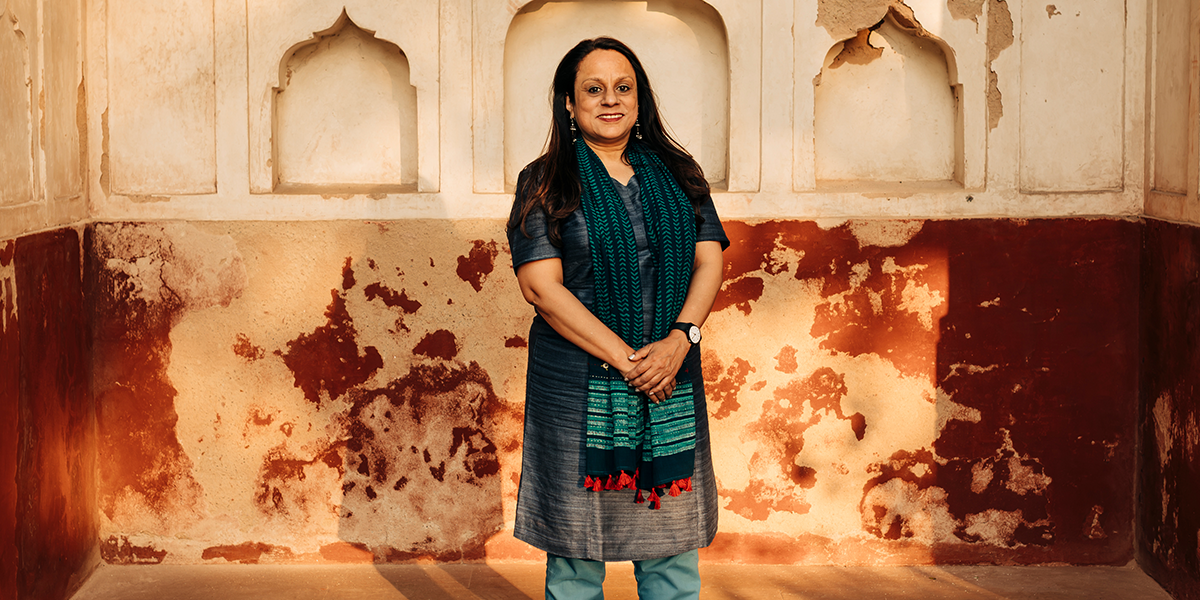 Professor Shruti Kapila
Finding the world a confusing place? Already consulted Plato, Aristotle, Machiavelli, Bagehot and Marx? Meet Professor Shruti Kapila, who has brought Indian political thought to Cambridge – and with it, new insights into the political phenomenon of our age.
Words :
Photography :
Published on:
1 April 2026
We’ve always seen the west as the crucible of political ideas, but in this global century I think India offers the most insightful space to examine where planetary and global life is going,” says Shruti Kapila, Professor of History and Politics.
“What it shows may not always be positive, but it allows us to see the scale of the challenge.” W“ India, Kapila says, is paradigmatic for understanding both modernity and the nature of the nation state.
“India was the first country to be decolonised, from the British Empire, since America,” she points out. “But India didn’t go down the communist or dictatorship route.
Nor did it follow a liberalism that was supposedly ‘bequeathed’ by the British Empire. Instead, Indians produced an entirely new vocabulary around questions of the state, of violence, and of religion – and that is fascinating and hugely important.”
Kapila was brought up in Chandigarh, a post-Independence planned city in north-west India. “Chandigarh was commissioned by India’s first Prime Minister, Jawaharlal Nehru (Trinity 1907), as a vision of what peace could look like after years of bloodshed,” she says.
“My parents moved there as part of that dream and part of the work of nation building. “India had always historically bucked the European trend, which is to say that it did not form its nationality on the basis of a single language or a single religion.
And that first generation of modern nation builders was very clear that India was going to instruct the world in this kind of unity in diversity.”
The national stories of this new India, she says, are not simply the outcome of European histories.
“They were produced by major political struggle over more than a century. The Indian National Congress (INC) party [founded in 1885] was the first explicitly anticolonialist political party in the world.”
It provided, says Kapila, significant inspiration for the global civil rights movements of the 1950s and 1960s. “Think of Mandela and Martin Luther King. The INC of Gandhi’s time created massive innovation both in mobilisation techniques, such as civil disobedience and in political language.
That had a domino effect across other Asian and African colonised nations. The result was a non-aligned movement that created a bloc of nations standing apart from the new ‘imperial’ divisions of a world run by the Americans and the Soviet Union.”
Kapila’s graduation from Panjab University in Chandigarh was followed in the late 1990s by a Master’s in History at India’s top-ranked Jawaharlal Nehru University in Delhi. “It seems like another time now,” she says.
“It was a moment when optimism around globalisation was very high. Knowledge should never have boundaries, but it was especially true at that time when I was coming up for graduate work.
There was an openness, a buzz of ideas. You felt like you were part of a major global moment, a celebration of human possibilities.” Kapila went first to London for a doctorate, then to Oxford, followed by Tufts in Massachusetts before arriving in Cambridge 15 years ago.
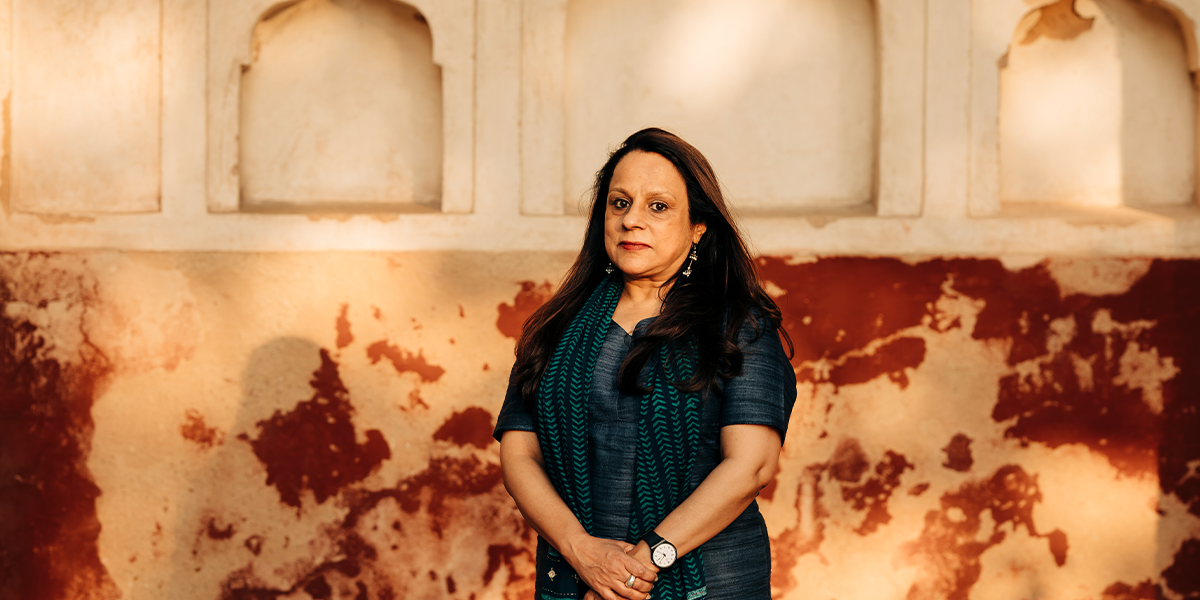
“I call it ‘Europe plus’: you have more than 20 languages, religious diversity and the world’s largest Muslim minority. This has compelled India’s political thinkers, and also those working with the economy or in tech, to think about problems very differently. Its scale forces innovation"
It was at just that moment, with the explosion of digital communication and the financial crisis of 2008, that the dream of globalisation began to sour.
“There was fatigue. The last positive embers of globalisation were dying,” Kapila recalls. “Finally, it all came crashing down.
High globalisation had produced prosperity, but also a kind of intimacy that is competitive and antagonistic, and an anger against established elites.”
But while analysis of the failure of globalisation often centres on discussion of Brexit or Trump’s America, in fact these trends showed up early and acutely in Indian politics.
“With Modi’s installation as Prime Minister in 2014 you see a revolt against liberal metropolitan ideas that goes on to be replicated in other major democracies.
Or with politicians’ growing refusal of mediation by editorial media, and instead speaking straight to the electorate.
We’ve seen a global arc of anger at liberal values, and that it happened in India’s mass democracy was the first indicator that this anger wasn’t simply restricted to non-democratic countries such as Russia.
It shows us this phenomenon isn’t simply authoritarianism, it’s the loss of liberal ideas and their power to persuade.”
It’s not the first time India has been a political bellwether for global change. Kapila’s 2021 study, Violent Fraternity: Indian Political Thought in the Global Age, shows how leading figures such as Gandhi, philosopher Muhammad Iqbal (Trinity 1905), BR Ambedkar (jurist and the key figure in the creation of the Indian constitution), and Hindutva founder Vinayak Savarkar, should be treated as innovative political thinkers as well as influential political actors. It was, says Kapila, a study that could only have been written in Cambridge.
“Indian history has been prominent in Cambridge, and the study of political thought has long been a flagship feature of scholarship here, so I felt this was the perfect place for this work.”
Kapila’s research has taken her beyond the academic community into mainstream journalism – and into the political sphere she chose not to pursue earlier in her career.
One long-running project organised with the House of Lords was a series of facilitated conversational meetings between the highest levels of the Indian and UK governments, including policymakers and academics.
“We had sessions on digital sovereignty, media and national security,” she says. “Many times, when political figures meet, they have to formulate a position or jointly sign up to something.
We tend to think of them as quite instrumental and focused on the next election. But because of the nature of the polycrisis in the world today, I find leaders very receptive to ideas. It’s freeing for them.”
“India has become a complex and sophisticated digital state, and Britain, in comparison, feels decades behind.”
Engagement with the political class and policymakers matters, because Kapila believes India offers valuable insights not only into the past and present, but into the arc of the future as well. Key to India’s instructional value is its scale.
“I call it ‘Europe plus’,” she says. “You have more than 20 languages, religious diversity and the world’s largest Muslim minority.
This has compelled India’s political thinkers, and also those working with the economy or in tech, to think about problems very differently. Its scale forces innovation.”
These ideas will be explored in Kapila’s forthcoming major work, New India: passion and power in the world’s largest democracy, which uses India as a lens to examine the story of democracy in the past 50 years, and the nature of the relationship of democracy with power.
“Among the most significant changes is in the nature of the state,” she says.
“India has become a complex and sophisticated digital state, and Britain, in comparison, feels decades behind.”
Recognition for her work came last year in the form of a letter that lay unnoticed in Kapila’s pigeonhole for 10 days. It was from the Cabinet Office, awarding her an OBE. “I only found it while waiting for someone to come into College for dinner,” she recalls.
“It was a total surprise, but in this turbulent age when everything can seem focused on technology, it feels like a real vindication of the centrality of the humanities and social sciences to understanding the world.
And of my major theme – that India’s story is central to that understanding.”
Shruti Kapila is Professor of History and Politics and recipient of a Leverhulme Major Research Fellowship.
Share this page