

The Shuar – an Indigenous people who have lived in the Ecuadorian Peruvian Amazon region for more than two and a half centuries – are used to conflict. So when they were faced with yet more state interference in their society, they didn’t flinch; they adapted. And, says Dr Natalia Buitron, their inventive solutions carry lessons for us all
Imagine your family are completely autonomous. How you live, where you go, who you live with and what you value are entirely your call. But over time, food becomes scarce and movement difficult.
You’re no longer able to live the way your people have lived for centuries. Now, you have to avoid encroachment and engage with state services – just to get hold of the things you and your children need, such as food, healthcare and education.
How do you organise yourselves into a cohesive group? What institutions do you create? What structures can defend your independence while ensuring the group is represented effectively?
These are the questions that the Shuar, an Indigenous group of people living in southeastern Ecuador, have had to grapple with over the past century.
And their inventive, intriguing solutions reveal a new way of thinking about state formation and political imagination.
“In the Global North, we have the Hobbesian fear that everything will fall apart without a central power,” says Dr Natalia Buitron, Jessica Sainsbury Associate Professor in the Anthropology of Amazonia. Buitron, whose lectureship was made possible thanks to a generous endowment in 2020 by fellow anthropologist Jessica Sainsbury (Jesus 1989), has close ties with the region – her father was a forestry engineer and her mother was a legal expert in Indigenous land rights – and has spent long periods living alongside Shuar people.
“The Shuar and many other rural/forest people’s movements around the world disrupt these dichotomies about how power operates. My research shows that Indigenous communities don’t just adopt external institutions – they creatively reinvent them.”
Javier Clemente Martinez

The Shuar – who form the largest of the Aénts Chicham-speaking conglomeration on the Amazon border between Ecuador and Peru – historically lived along the banks of rivers in small, close-knit kinship groups, with substantial zones of no man’s land between each group. From the late 19th century, two powerful groups disrupted this way of living – the government forced the Shuar off their land and cleared it for agriculture, while missionaries moved in to ‘civilise’ them.
So far so predictable, but what happened next proved more surprising and powerful than outsiders could have ever imagined.
While it was decided that the Shuar people would be forced into villages and given land and cattle to start cooperatives – to assimilate them into Ecuador’s nation state – the Shuar themselves had other ideas.
They came to realise that their own autonomy and prosperity increasingly depended on access to external resources and powers, so they found pragmatic ways to interact with the central government. In doing so, their own communities were transformed.
“Once the cooperatives were up and running, Shuar people began to work out how to turn this state-led system into a weapon of resistance,” says Buitron.
“They looked at it as a way to gain their own titles, become owners of their own lands and gain access to the services that was being given to other settlers – such as schools, roads and hospitals – but not them.
“The cooperatives were the institution that enabled the idea of coming together under some form of association in a nested structure. Cooperatives became groups of villages, which became the Shuar Federation in 1964 – one of the earliest Indigenous resistance organisations in Ecuador. By mimicking the structure of the state, they were able to take it on.”
The Federation had leaders, democratically elected, who spoke on behalf of their constituents.
This was an organisation that made sense to the Ecuadorian state – so it had to recognise it and speak to it.
Since then, the Shuar have utilised similar federations to negotiate with national institutions and keep their way of life alive, using what Buitron calls their “institutional plasticity” – adapting state systems to meet their own needs.
Encroachment from cattle ranching means they are no longer able to provide for themselves from the forest: but they need to be able to feed themselves.
The Shuar need leaders: that means access to education and university, which requires an education infrastructure. All these things require access to public budgets – and to do that, they will elect people to regional governments and make alliances with NGOs.

Javier Clemente Martinez
Decisions are made by drinking many a manioc beer together, working together, sharing stuff, fighting and then occasionally agreeing about the course of action
But while these systems might look similar on the surface, the reality of how they operate is very different.
A federation council has members, councillors, directors – echoing the kinds of institutions that democratic governments understand and can engage with. But the real power lies locally.
“For example, if you want to go and visit one of those villages that the federation supposedly represents, they might give you a letter saying, yes, you can travel because you look like a decent person,” says Buitron.
“But to access that place, you need to talk to the people who live there. They hold the power, not the federation. It is incredibly decentralised. You have to figure out who might be able to introduce you to the people who might be influential enough to take you around for visits to different households. Then someone calls an assembly where people debate for hours, until they decide that yes, you’re a decent person.”
This local decision-making process is constantly in flux. There are formal structures, says Buitron, but they don’t determine the character of everyday life.
“Decisions are made by drinking many a manioc beer together, working together, sharing stuff, fighting and then occasionally agreeing about the course of action. Eventually, all these daily processes may create something that looks like a decision, which eventually acquires a formal shape.”
There are times, of course, when the community does come together
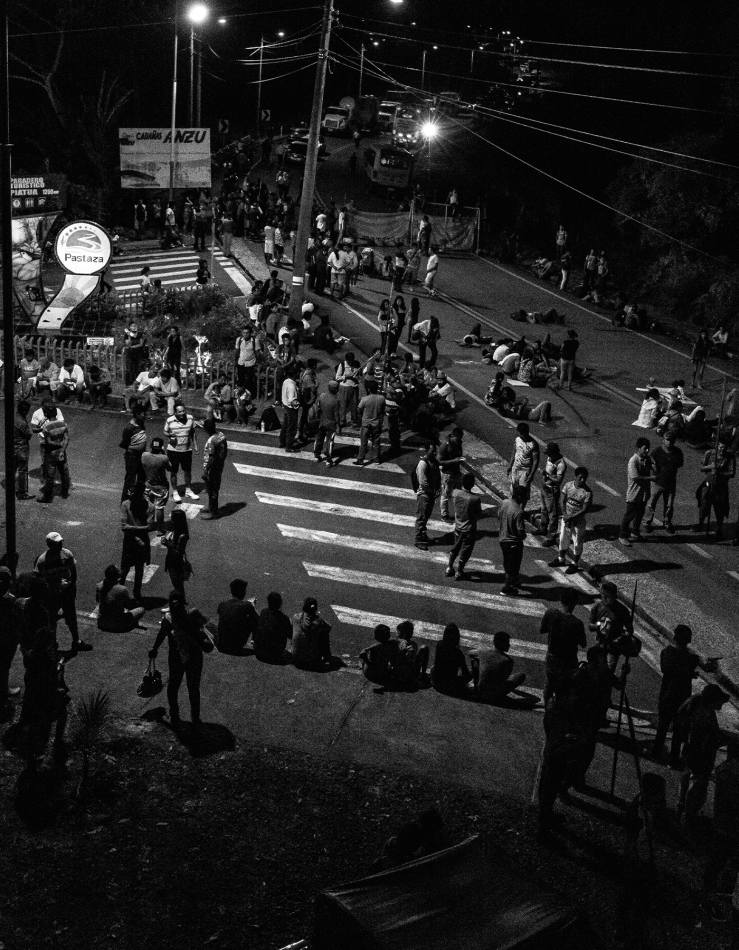
In moments of conflict with the state, for example, Shuar federations will appear as a single resistance movement.
“But coming up with that sort of structure will have taken a lot of work, a lot of assemblies, a lot of intra-household visits. And in no way is the decision being made centrally.”
This is also nothing like the stereotype of the communistic, collectivist Indigenous community, she points out.
Once the Shuar were given central resources, authorities had certain expectations about how those Indigenous villages should run.
“In the 1950s, the assumption was that they were completely anarchic, lawless and savages. Now, the assumption is, oh, they’re Indigenous, they have cooperatives, they have communities and run assemblies. They must be communistic and collectivistic, because that’s how we expect Indigenous peoples to be. But they are nothing like a collective, though they create the fiction of a collective in a very powerful way.”
Say, for example, the Shuar are offered money for a new ecotourism enterprise and told how they should build it. An elected leader might mediate that process on a regional level to get the money.
But families within the community will make it very clear that things will be done their own way.
“One might want an ecotourism enterprise; another might want a fish nursery. The community will support families to harness these resources by creating a minga – a collective work party, which is also appropriated from a neighbouring Indigenous group. But they won’t turn up every day and work together to a rota. The community is not responsible for the outcome of that project, or the resources they are harnessing.”
What might we learn from the Shuar’s structures? Of course, we can’t simply take a way of life that’s formed over centuries and expect to replicate it in a completely different context.
And, says Buitron, there are many models of democracy where hierarchy works well. Rather, it’s the Shuar’s ability to adapt, grow and change within power structures which could help us move towards something better for everyone.
“It’s the ability to think flexibly, and not confuse flexibility with chaos,” she says.
Javier Clemente Martinez
The Shuar will make something routine. But when it’s not working, they’ll change it.
If a leader is not doing their job, they will change him or her. Sometimes they won’t even have elections.
They’ll try something different because they don’t have our established patterns.
I think that shows we can be flexible – and that doesn’t mean things will collapse.”
That kind of thinking is, she admits, frustrating for anthropologists who have been repeatedly assured that a fascinating festival is definitely happening – until it isn’t, and nobody seems particularly troubled by it. (Apart from the anthropologist.)
“I’m not going to romanticise it, but in the long run there is something incredibly productive about the possibility of changing things.”

Javier Clemente Martinez
You can design the most beautiful carbon credit system in the world – but if people have no real part in it, it’s going to fail
Right now in the Global North, Buitron points out, there is a sense of being stuck, of not being able to really change anything.
“We don’t know how to tackle climate change, for example, because we don’t know how to change the current structure, the political economy that’s brought us here.
“The Shuar have developed this way of doing things because they have confronted incredible challenges. They have been colonised. They have faced off huge threats. Resilience is their best friend. They can accommodate their solution to the current situation at hand.”
And the failed experiment in moulding the Shuar into what the government wanted them to be should teach us that without dialogue, cooperation and alliances, change simply doesn’t happen – however good our intentions are.
“You can design the most beautiful carbon credit system in the world, for example – but if people have no real part in it, it’s going to fail,” says Buitron. “You have to work with those people. When they tell you how they operate, you have to listen. Otherwise, it will fail.

Javier Clemente Martinez
Captured in photography
The soft crackle of fire accompanies daily meals and storytelling, and is also key to preparing a new garden for cultivation.
The Shuar have a short myth that tells how Jempe, the hummingbird, stole fire from Takea, the owner of fire, with the tail of its feather and gave it to humans, who were then able to use it for cooking.

Javier Clemente Martinez
A member of the Indigenous resistance protesting against extractive companies.

Javier Clemente Martinez
Fish trapping is not only a subsistence technique: it also activates important forms of intergenerational knowledge transmission and connections to the riverine environment.

Photo by Dr Natalia Buitron
Cambridge owes its world-leading excellence in research and teaching to the commitment and generosity of its friends and supporters. Our history is synonymous with a history of enlightened benefaction, and the same is as true in the 21st century as it has ever been.
Roadblock in Macas, Morona Santiago. Photo captured by Dr Natalia Buitron.

Javier Clemente Martinez
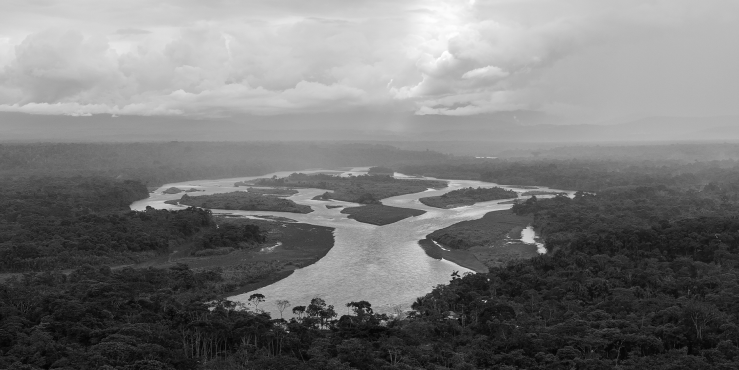
For the Shuar, land is not an inert resource but a living realm inhabited by masterowners of game and plants, with whom social relations must be cultivated.

Dr Natalia Buitron
Dr Natalia Buitron is the Jessica Sainsbury Associate Professor in the Anthropology of Amazonia, and Director of Studies at Jesus.
Her work explores political subjectivities, indigeneity and development – specifically how broader political and economic forms interweave with moral transformation in daily life. She has researched, written and taught on a wide range of issues relating to Indigenousstate relations, inequality and intercultural education.