
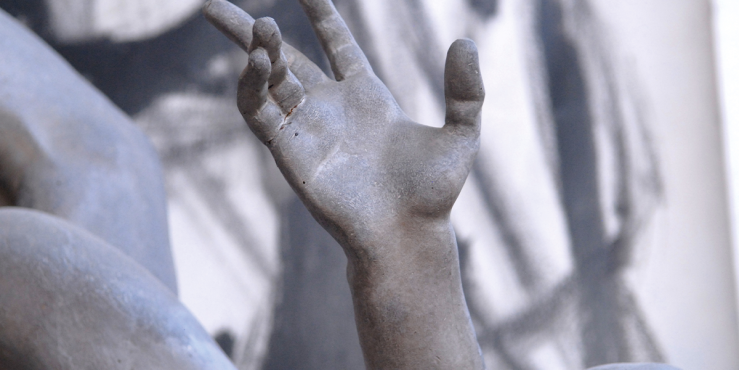
What happens when the modern and the classical collide? There are some strange, beautiful and illuminating things happening at the Museum of Classical Archaeology – but it all starts with plaster.
They are not marble or bronze. They are mostly not terribly old. Many are not valuable. Yet the Museum of Classical Archaeology (MoCA)’s extensive collection of plaster casts – busts, sculptures, complete friezes – is prized by its curator, Dr Susanne Turner (Darwin 2004) no less than the original artifacts in the museum’s care.
“They’re mostly Victorian replicas,” she explains. “And replicas are a funny class of objects, aren’t they? They fall betwixt and between all our usual categories. They possess meaning because they have an indelible link, like an invisible string, connecting them to something that is two and a half thousand years old, and is somewhere else in the world today.”
Possessed of this enigmatic duality, plaster casts have a fascinating history all of their own – one that has inspired artists and scholars alike.
“Plaster casts have been a thing since Ancient Rome,” explains Caroline Vout (Newnham 1991), Professor of Classics and Director of the Museum. “The Romans made plaster casts of Greek sculptures, and they were used by artists throughout the Renaissance. They were one of the ways classical art became an international language of power and influence in court societies and beyond, all over Europe.”
The 18th and 19th centuries were the heyday of the plaster cast, a time when replicas of statuary and reliefs were brought to Britain in substantial numbers by travellers who had undertaken a Grand Tour of the continent. “These were aristocrats, the wealthy, the types of people that were learning Latin and Greek,” Turner says.
“As part of their education they would go on a little jolly around Italy, maybe a bit of Greece if it was safe. They ate a lot of Parmesan, drank some wine, probably had liaisons with members of the opposite sex – or the same sex – and then brought home a souvenir. Sometimes that could be a portrait of themself next to an ancient sculpture, maybe fondling an Aphrodite. But sometimes it was a plaster cast. By the middle of the 19th century, there were plaster-cast workshops in all the major European cities.”
With those same workshops also supplying great museums and educational institutions, and philanthropic collectors donating their assemblage of casts to deserving seats of learning, plaster casts democratised access to the treasures of the ancient world.
Turner explains that a government programme to upskill workers in art and design skills to equip them for the industrial age meant fine art schools in northern major cities could use grants to obtain plaster casts for free.
A cast makes something come alive, maybe unexpectedly, because there’s an interaction you perhaps wouldn’t have recognised if you were just studying the object through an archive. It’s playful. There’s both humour and emotion in our expectation of what an object is, and what it isn’t.
What’s plain, even by this time, is that plaster casts occupy an ambiguous cultural space – one perfectly illustrated by the history of Cambridge’s own collection, which today numbers around 1,000 pieces.
“Our earliest casts were given to the University in the 19th century and went straight into the Fitzwilliam Museum,” says Vout.
“There, catalogues talk about them as though they are the real thing. So, at that point, they were considered artworks. Then as you get to the end of the 19th century, when notions of authenticity are being more explicitly discussed, they were moved out of the Fitzwilliam into the designated collection that is the forerunner of today’s Cast Gallery.
Here, they became what Mary Beard has called ‘specimens in a lab’. They were used rather like PowerPoint presentations, as teaching aids.”
A large cast collection enabled scholarly analysis that was beyond the scope of purely authentic collections, in turn driving the acceptance of classical archaeology as a field of research.
“With casts, you can build chronologies,” Vout explains.
“Even a museum as powerful as the British Museum doesn’t have very much 6th-century BC monumental sculpture, but if you have a plaster cast collection with a gap like that, you can just go and buy what you need.
That enables the construction of a history of style.
It also meant scholars in the mid to late 19th century used casts and photographs to identify works named in specific classical texts, such as Pliny’s Natural History.
This was instrumental in establishing archaeology as an academic university discipline.”
So from the start, cast collections entwined popular and scholarly study, and inspired artists and academics alike.
What’s perhaps more surprising is that they continue to fulfil this role today, when there are many more ways of accessing originals, from online photographic catalogues to budget flights to Greece and Italy.
So why still keep and look at casts?

Photography by Dr Susanne Turner
The University of Cambridge’s 800th anniversary was marked not only by a year-long series of celebrations but also with a record-breaking £1.2 billion fundraising campaign.
“Is studying casts in any way better or worse than looking at originals?” asks Allison Ksiazkiewicz (Darwin 2007), a multidisciplinary artist who is currently exhibiting at the Cast Gallery.
“What do they tell you that is different from what the originals tell you? For me, that question sparks all sorts of interesting discussions about authenticity, forgery and originality.”
Ksiazkiewicz’s installation, Culture Canines: Evolution, Emotion, Imitation, plays explicitly with notions of authenticity.
It comprises 12 ceramic pieces that look like Greek Attic pottery with its distinctive black-and-red design – which on closer inspection reveal the forms of dogs entirely unknown to Ancient Greece.
Ksiazkiewicz says she was inspired by hearing passionate dog breeders telling mythologised tall tales about their beloved breeds.
“They love these stories of their breed’s golden age that never really existed, which got me thinking about the cultural histories we tell ourselves. And then one day an image popped into my head of the famous collector and envoy to Naples Sir William Hamilton acquiring a vase dug up at Herculaneum that had an [ahistorical] chihuahua on it. It made me smile, but I also realised it was a really good way to explore questions of invention and authenticity.”
In pursuit of the most authentic, inauthentic objects possible, Ksiazkiewicz teamed up with an Athenian workshop, Attic Black, which produces museum-grade replicas of classical and prehistoric Greek ceramics.
Just like the Victorian-era plaster casts, Attic Black’s output spans reproductions for institutions and high-end souvenirs for tourists.
Ksiazkiewicz was hands on throughout the collaborative manufacture, providing specifications for the ceramics then painting them.
“It’s very different from working in archives,” she says.
“It makes something come alive, maybe unexpectedly, because there’s an interaction in the making that you wouldn’t have recognised if you were just studying the object through an archive.”
Seeing her works now displayed in the Cast Gallery gives her enormous pleasure, she says, because it’s a setting that captures how a thing can be both authentic, in a way, but also modern.
“It’s playful. There’s both humour and emotion in our expectation of what an object is, and what it isn’t.

Photography by Dr Susanne Turner
The School of Arts and Humanities is concerned with the study of human culture, exploring, informing and enriching how we live. The School encompasses music, English, architecture, the history of art, philosophy, religion, classical antiquity, the study of Asian and Middle Eastern cultures and modern and medieval languages. Alumni include Christopher Marlowe, Mary Beard, Bertrand Russell, Sylvia Plath, CS Lewis, Alan Bennett, Alfred Lord Tennyson, Zadie Smith, Ralph Vaughan Williams and Iris Murdoch.
Vout agrees. “The act of reproduction has been an act of play as much as it’s been an act of reverence ever since Ancient Romans were adapting and appropriating Greek art,” she says.
“And that playfulness enables us as curators to be playful too, and to bring out the artfulness of the casts and be a little irreverent with them in all sorts of ways.”

Photography by Dr Susanne Turner
Alongside its permanent collection, MoCA stages two or three exhibitions a year from local and international creators, such as Norfolk artist Mark Mann’s A Room of One’s Own, which explores “the bravery of the queer interior”.
This included classically styled pieces, harking back to the inspiration and comfort that queer communities have long drawn from the visibility of same-sex love in the classical world.
Ceramicist James Epps brought dazzling hues to the Museum when he installed large-scale mosaics shaped by the use of pattern and colour in Ancient Rome, inspired by studies both on site in Italy and among the MoCA’s plaster casts.
But while Ksiazkiewicz, Mann and Epps engage specifically with classical forms, many of the Cast Gallery’s exhibitions do not.
“Sometimes abstract things work really beautifully,” says Turner.
“They push back against the classical. And given that most visitors who see these exhibitions probably didn’t come specifically for them, it’s a fantastic opportunity not only to reach a new audience but also to help them along, because these visitors came to see the classical body – and instead they’re being presented with contemporary art.”

Photography by Susanne Turner
The School of Clinical Medicine is recognised as a leader in biomedical research, clinical education and healthcare innovation.
Today, MoCA’s offering interweaves all strands of the complex history of plaster casts.
The Cast Gallery remains a site of academic instruction – “I still take my undergraduates in there for their first supervision,” says Vout, with a touch of mischief.
“We ask them to comment on objects, which can really throw them because they’re used to talking about how texts affect us, but they’re not trained to articulate why sculpture does.”
With regular Drink and Draw evenings, the Museum honours the artistic instruction heritage of plaster casts – a valuable role given Cambridge has no fine arts department.

Photography by Dr Susanne Turner
The School of the Humanities and Social Sciences is concerned with human behaviour, its history and continuing development through the study of archaeology, anthropology, politics and international studies, sociology, economics, history, the philosophy of science, law, criminology and land economy. Notable alumni include John Maynard Keynes, Eric Hobsbawm, Simon Schama and Siegfried Sassoon.
Above all, the collection keeps asking the questions plaster casts have posed since their inception: Where does authenticity begin and end? What might you see if you look hard enough?
"At the Museum, we see the life drawing, and the contemporary art shows, and the studying we might do in a supervision as part and parcel of the same cultural aim,” says Vout.
“And that’s to get people to look and to see differently.”
Would you like to exhibit at MoCA? The museum welcomes exhibition proposals from artists of diverse backgrounds, and would love to hear from you if you would like to interpret its space or collection in creative ways. To propose an exhibition, contact the Curator Dr Susanne Turner at smt41@cam.ac.uk.