 CAM
CAMAlumni life
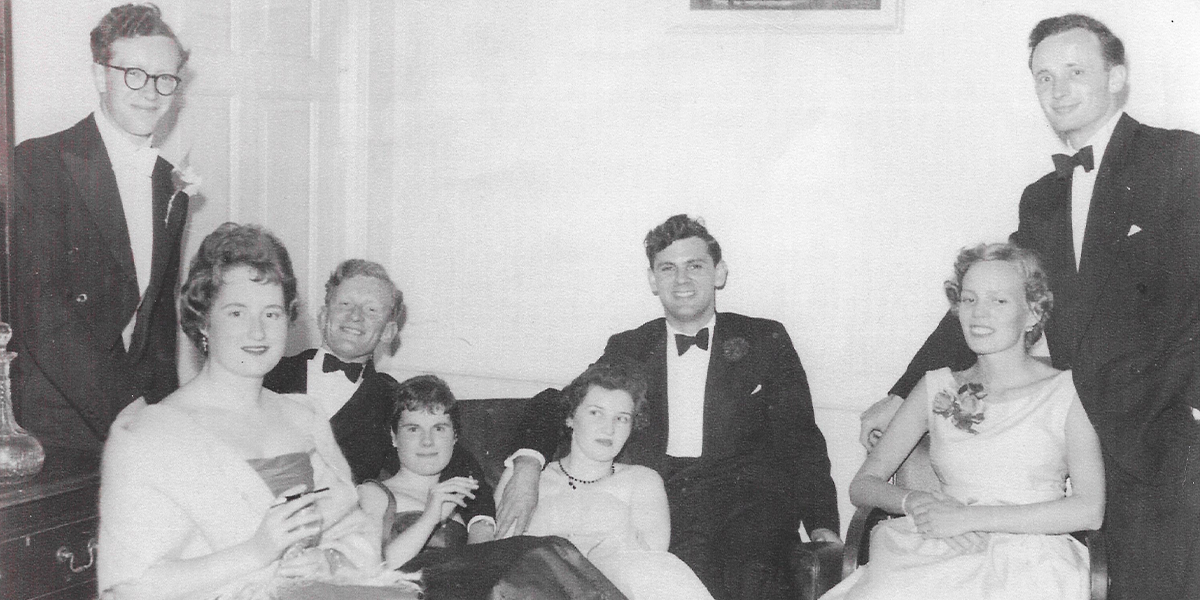 From right to left: Roger Mowll (Queens’ 1956) and wife Judith, Roger Duffett (Peterhouse 1956) and wife Julie, with friends at the Peterhouse May Ball in 1959.
Crick said he and Watson had discovered the helix structure. The academic community said: ‘Looks promising. Now you’d better go and prove it.’
The 1959 night at the Eagle pub when Francis Crick and James Watson declared they had discovered the ‘secret of life’ is the stuff of legend.
But that night was not the end of something, it was just the beginning. And one man who would go on to become an intimate part of the story recalls it well.
“There was a hell of a fuss!” remembers Roger Mowll (Queens’ 1956). “Crick said he and Watson had discovered the double helix structure and the media went wild.
But the academic community said: ‘That’s all very well. Looks promising. Now you’d better go and prove it.’”
A team was put together to do the hard work – obtaining high-quality crystals, X-ray photographing them and analysing the diffraction patterns by feeding them into EDSAC 2 (Electronic Delay Storage Automatic Calculator).
Mowll was approached, along with his lifelong friend Roger Duffett (Peterhouse 1956).
“Roger and I had both graduated and we’d been playing tennis and swanning about before we were to start our jobs at BP, who had sponsored us,” says Mowll.
“But when the head of the Cavendish Laboratory Professor Max Perutz offered us the job of proving Crick’s claim, of course we wanted to accept. And so BP agreed to give us a month’s grace.”
The two Rogers were stationed in Crick’s office, in a Nissen hut next to the Cavendish building, where Perutz had his lab.
The first time we showed the sheets to Perutz he said: “That’s it!” Then: “Run it again!” Crick had never been in any doubt, so Roger and I just went for a beer at the pub opposite Peterhouse
“Crick was there but he was so confident he seemed quite uninterested in proving his discovery.
Watson had gone back to the States and Dr Rosalind Franklin (Newnham 1938), who was responsible for producing the crystals we needed, had sadly died earlier that year, so we never met her.”
Franklin’s lab in London made the best RNA and DNA crystals, says Mowll, “and one of her ladies brought them up to Cambridge. X-ray photos of them were taken, and Roger and I had to sort out putting them into the computer and then collecting the results.”
First, the two Rogers measured the “shadows and intensities” – the X-ray diffraction – in the photos.
They then transferred the measurements onto punch tape as a series of holes representing binary data.
This was fed into the EDSAC 2, the world’s second computer.
“It was painstaking work,” says Mowll.
“The computer chamber was enormous, the size of an aircraft hangar.
And it was boiling hot, because it had valves, not transistors, which created a lot of heat. It took about half an hour to climb a ladder to feed the tape in, by which time you’d be sweating heavily.
The computer then cranked away throughout the night, and by the morning, four sizeable sheets would have come out.
“The first time we showed the sheets to Perutz he said: ‘That’s it!’ Then: ‘Run it again!’ We did it three or four times.
What came out was a series of lines and numbers which I couldn’t really decipher and which I wasn’t sure would add up to a double helix.”
The whole thing took about a month, and by the time Perutz was satisfied, it was a bit of an anticlimax.
“Crick had never been in any doubt – for him, the process was barely necessary.
So Roger and I just went for a beer at the Little Rose pub opposite Peterhouse.
And then began the discussions over who would apply for the Nobel Prizes!”
In the end, the Nobel Prize for Physiology or Medicine of 1962 went to Crick, Watson and Maurice Wilkins, who had worked with Franklin, “for their discoveries concerning the molecular structure of nucleic acids and its significance for information transfer in living material”.
That same year, Perutz and John Kendrew won the Nobel Prize for Chemistry “for their studies of the structures of globular proteins”.
The two Rogers went on to pursue successful careers at BP, and watched in bemusement as the Bene’t Street blue plaque row unfolded a few years ago, when a graffitied plaque on the Eagle’s wall was replaced and updated to recognise the role of Franklin, Wilkins and “other scientists” in the discovery.
(Indeed, it was this story in issue 103 that prompted Mowll to get in touch with CAM in the first place.) But both still get together for walks and lunches, and to reminisce about the time they helped to discover the secret of life.
Share this page